
75 years of Metallurgy at The University of Queensland - laying the foundations for the future.
This year marks 75 years of metallurgical engineering at The University of Queensland (UQ). Starting from modest beginnings in old wooden buildings in George Street, downtown Brisbane, the metallurgy program has grown and diversified to encompass a wide range of teaching, learning and research activities.
The Department of Mining was established in 1950 at UQ with backing of the AusIMM and financial support from the Queensland Government through the Queensland Chamber of Mines. In 1951 the department was officially renamed the Department of Mining and Metallurgical Engineering. The founding Head of Department, Prof FTM White, was a metallurgical engineer by training
In those early years the undergraduate programs in mining and metallurgy were intricately linked and the courses offered covered the whole value chain from ore geology through to metal manufacturing. The first two years of the program were common between undergraduate mining and metallurgy programs. As time progressed the curriculum offerings expanded and more specialised courses developed.
Major revision to the metallurgy program came in 1988 when the metallurgical engineering split into separate degrees – minerals process engineering focussed on the physical and chemical processing of minerals and metals, and materials engineering focussed on new materials and downstream processing. This development led to a major shift in the teaching of minerals process engineering, with the first establishment of collaborations with the Department of Chemical Engineering to share the teaching of common courses in respective degree programs. Following recommendations of a joint UQ/industry working party on mining and metallurgical engineering education, a more formal relationship was developed, and in 2006 the BE Chemical and Metallurgical Engineering dual major degree was approved. This proved to be a successful union and, with generous industry backing from Xstrata Copper, BMA and the Minerals Council of Australia, graduate numbers increased.
In 2020 UQ undertook a major restructure and rationalisation in course offerings across the university. A casualty of this restructure was the discontinuation of the Chemical and Metallurgical Eng dual major degree program. In place of a stand-alone degree, Metallurgical Engineering is now offered as a major elective stream in the BE Chemical Engineering. Similar major structural changes took place with the Mining degree. Mining Engineering is now offered as a major elective stream in BE Mechanical Engineering, or as a major elective stream in BE Civil Engineering. Material Engineering is an elective program in the School of Mechanical Engineering.
Developing the research profile
In parallel with the changes in the undergraduate program significant changes have taken place in postgraduate education. In the early days of the Department the focus was on teaching of current professional practice. There was little or no laboratory equipment available and progress in developing higher degree programs was relatively slow.
It was not until 1965 that the first PhDs were awarded in mining and metallurgy at UQ. Based on the groundbreaking work undertaken by Alban Lynch and his research team, in 1970 the Julius Kruttschnitt Mineral Research Centre (JKMRC) was formally established. This provided the vehicle for a major expansion in research activities focussed on the application of emerging computing capabilities to the modelling and control of mineral processing operations. The JKMRC formed the basis in 1991 for the Sir James Foots Institute of Mineral Resources, which included the JKMRC, the WH Bryan Mining Geology Research Centre (BRC), and the Centre for Mined Land Rehabilitation (CMLR). In 2001 the Sustainable Minerals Institute (SMI) was established incorporating the Sir James Foots Institute’s activities.
The university began its life as a state-based institution. However, in 1974 with the Australian Commonwealth government taking responsibility for university education nationally, UQ sought to increase its national and international profile, in doing so it started to invest in research infrastructure for this development. This investment, and the provision of affordable access to these facilities, was critical for the development of innovative research in minerals and metals processing. UQ now boasts world class research activities in minerals processing, hydrometallurgy and pyrometallurgy – a claim confirmed by consistent international ratings of UQ teaching and research in mining and metallurgy.
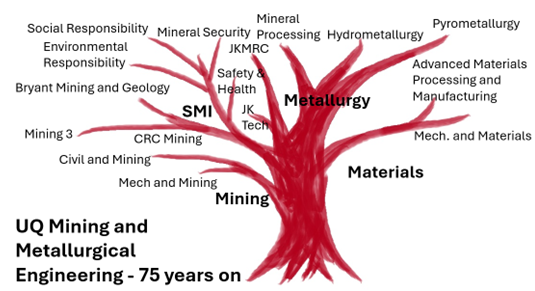
UQ metallurgy has grown organically over its lifetime, from modest beginnings to teaching and research leadership. The scope of these activities is illustrated schematically in the accompanying figure.
The future of metallurgical engineering
This is a story of what has been, and what can be, achieved when there is close association and support of the minerals industry. This approach has been the key to the development of high quality metallurgical teaching and research programs at UQ. The future of the discipline in Australia is critically dependent on the application of these same principles.
With clear needs for the stable and increased supply of metals in coming decades, now is the time to build on this sound foundation. Through active engagement and mutual support, industry and universities can build further capability in core metallurgical engineering programs, and deliver the educated metallurgy workforce and the innovations needed for the minerals industry of the future.
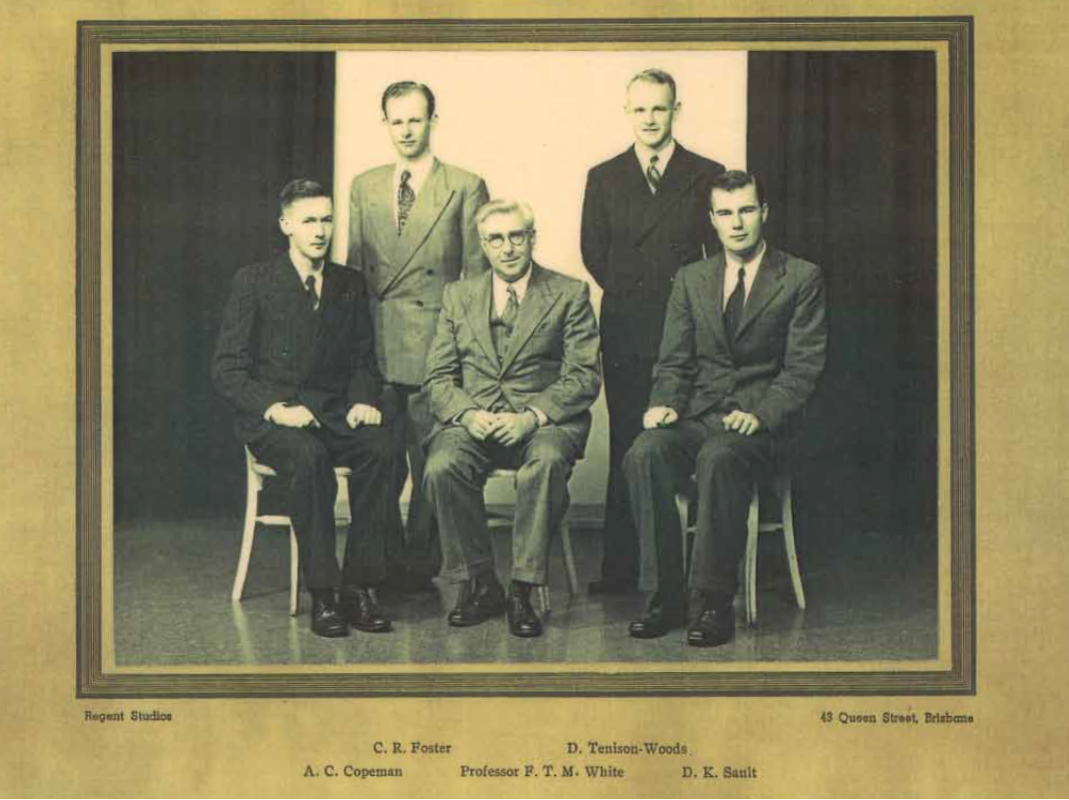
Graduating class UQ Mining and Metallurgical Engineering 1950, (L to R: A.C. Copeman, C.R. Foster, Prof. F.T.M. White, D. Tenison-Woods, D.K. Sault)