
Brisbane Technology Forum November 2026: Smarter, Safer, More Sustainable: Technology in Action Across Mining

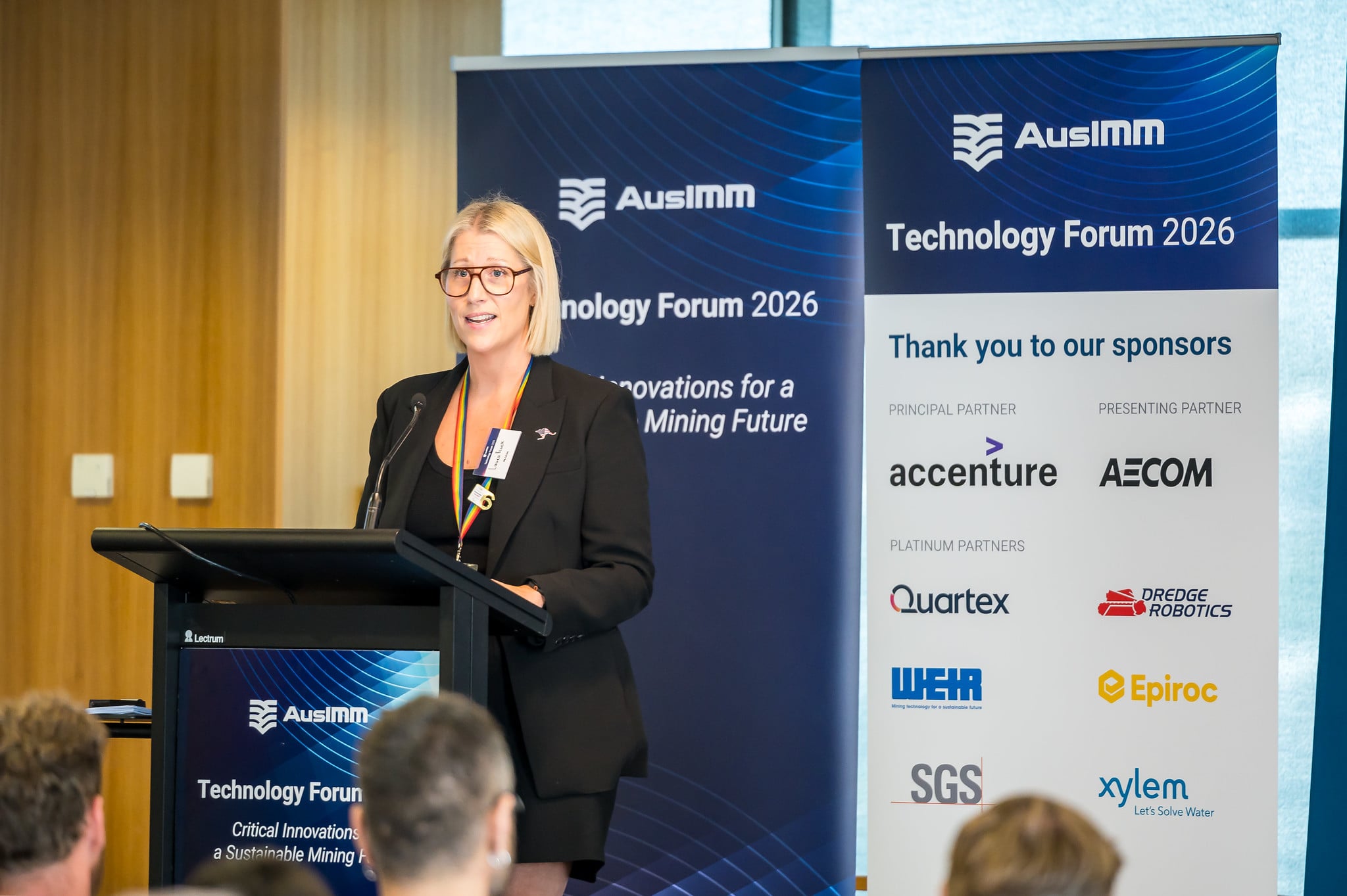
As technology continues to reshape the mining sector, AusIMM’s eighth Technology Forum brought industry leaders, innovators and practitioners together once again in Brisbane to discuss How digital transformation is driving value across mining, delivered in partnership with AECOM at its Fortitude Valley office.
Across the presentations, a consistent theme emerged: technology delivers the greatest value when it solves a clearly defined operational challenge. Whether through robotics, AI, improved asset data, water recovery, equipment design or digital safety systems, successful transformation depends on connecting technology with the people, processes and systems that turn insights into action.
Key takeaways for industry
- Mining is shifting from operating assets to operating intelligence, enabled by smarter assets, predictive operations and context-rich data
- Robotic inspection can help remove people from high-exposure environments while making inspections more frequent.
- Digital twins, connected assets and advanced simulation are improving equipment performance and enabling more predictive decision-making.
- Strong data governance combined with AI can turn complex and fragmented project information into usable operational data.
- Digital safety systems can strengthen the connection between hazard identification, control actions and verification.
- Technology-led innovation is also creating opportunities to improve water recovery, reduce project complexity and deliver significant capital and operating savings.
Successful digital transformation depends on connecting technology with existing systems, operating models and people, rather than treating technology as a standalone solution.
From insight to action: How digital transformation is driving value across mining
Presented by: Sumit Sharma, Managing Director Accenture ANZ, Mining & Resources + Supply Chain & Engineering
Mining is shifting from operating assets to operating intelligence through five key shifts: intelligent assets, predictive operations, an augmented workforce, context-rich data and strategic partnerships.
The fastest movers are focusing on one well-defined job with a clear owner, a payback and results operators can trust.
Robotic inspection is one practical example of this shift. Robots can keep people out of high-exposure areas while enabling inspections to take place more frequently. However, the value is only realised when findings flow through a trusted Observe → Analyse → Act workflow.
The presentation explored three use cases, including conveyor inspection, process plant inspection and haul truck inspection, demonstrating how these technologies can be applied to real operational environments.
To scale successfully, findings need to feed into maintenance systems, supported by robot-ready plant design, a redesigned operating model and people remaining in the loop.
Water Scarcity, ESG and Rising Costs: Rethinking Zero Liquid Discharge with a One-Step Approach
Unlocking water recovery from high-salinity mining streams while reducing complexity and project risk
Presented by: Alan Tan, Treatment Solutions Manager, Xylem
Mining operations are facing increasing pressure to reduce freshwater consumption, maximise water recovery, manage complex brines and meet evolving ESG and environmental requirements.
The presentation explored how Zero Liquid Discharge (ZLD) can help address these challenges and introduced Xylem’s VACOM One-Step ZLD technology.
Unlike conventional ZLD systems that require separate evaporation and crystallisation processes, VACOM combines both into a single integrated solution, reducing complexity, footprint and operating costs.
Through industry case studies and mining-relevant applications, the presentation demonstrated how a simplified ZLD approach can improve water security, enhance sustainability outcomes and support future mine water management strategies.
Successful Implementation of a Unique Brownfield Conveyor Tie-in at the Cadia East PC1 Expansion Project
Presented by: P Garvey, Engineering Manager, AECOM Australia
The T45 transfer station project at Cadia East underground mine provided a case study in optimised materials handling by connecting the PC1 Expansion directly to the operating CV3033 incline conveyor.
A structured value-engineering review replaced an original six-conveyor, five-transfer network with three conveyors and three transfer stations, delivering AUD 30 million in capital savings and more than AUD 35 million in operating cost savings.
The central technical challenge involved excavating an 8,000 m³ chamber directly above the live incline conveyor. To protect the existing infrastructure, a steel arch protection shield was erected and validated beforehand through a full-scale surface trial.
The project was commissioned in 2026 without conveyor downtime, demonstrating how safe and innovative brownfield expansion can be delivered adjacent to critical operating infrastructure underground.
Using Advanced Technology to Solve Operational Challenges: How ESCO’s Recent Bucket Design Process is Improving Onsite Reliability and Productivity
Presented by: Rod Clarke, General Manager of Advanced Technology, Weir
Mining’s next competitive advantage will come not from collecting more data, but from using it more effectively.
As operations become increasingly connected, digital technologies are enabling greater visibility, faster decisions and improved performance across the mining value chain.
The presentation explored how Weir is applying connected assets, digital twins, advanced simulation and real-time operational intelligence to solve complex mining challenges.
Through practical examples and field-proven results, Weir’s Advanced Technology ESCO Division demonstrated how data-driven insights can improve equipment performance, increase productivity, reduce maintenance costs and support safer, more sustainable operations.
The presentation also highlighted how combining engineering expertise with digital innovation is helping the industry move beyond reactive management towards predictive and increasingly autonomous decision-making.
Safer Sites Start Before the Incident: From the hazard your crew spots to the action that controls it, in one place
Presented by: David Putz, Safety Product Lead, Quartex
Drawing on six months of co-design with safety teams at eight mining, resources and heavy-industry companies, the presentation explored four recurring themes identified by industry.
The session looked at the challenges that shaped the development of Quartex Safety, why safety expectations are shifting and what due diligence looks like when officers need to verify that hazards are controlled rather than simply assume they have been addressed.
A live walkthrough of Quartex Safety demonstrated how a product developed alongside industry can respond directly to the challenges safety teams identified and better connect the hazard spotted by a crew with the action taken to control it.
From Data Chaos to Operational Readiness: How Governance and AI Improve Asset Data Quality
Presented by: Ruben Sen, Brisbane State Manager, SGS
The presentation explored how data governance and agentic AI can turn complex and inconsistent information into useful data for operational readiness.
A safety example demonstrated how data helped identify and correct non-compliant hazardous-area equipment weeks before start-up by comparing commissioning and engineering information.
The presentation also examined an iron ore project where Agentic AI was used to review 32,806 hand-filled Inspection Test Records (ITRs) against 38,000 tags, extract information from the records, have EDM check it and load it into AVEVA as as-built data.
The example demonstrated how stronger governance and AI can support improvements in asset data quality while helping project teams turn large volumes of information into reliable operational data.
From insight to action
Across the forum, a clear message emerged: digital transformation in mining is increasingly moving from exploration into practical application.
The examples shared by speakers demonstrated that technology delivers the greatest value when it is connected to a specific operational challenge, integrated into established systems and supported by the people who will ultimately use it.
Whether removing people from high-exposure inspection environments, improving the quality of asset data, increasing equipment reliability, strengthening safety processes or improving water recovery, the focus is increasingly on turning insight into action and demonstrating measurable operational value.
The opportunity for mining organisations is therefore not simply to adopt more technology, but to identify where it can make the greatest difference and build the systems, processes and operating models needed to scale successful applications.
AusIMM would like to thank all speakers for sharing their insights, case studies and practical experiences, and our partners for their support in bringing the Technology Forum together.
By bringing industry, technology providers and practitioners into the same conversation, the Technology Forum provides an opportunity to examine what is working in practice and how innovation can be translated into safer, more productive and more sustainable mining operations.