
History and heritage: Captain Oliver Holmes Woodward - His growing mining legacy
A chance discovery of an unknown German Great War photograph in Belgium military records has added to the already impressive war legacy of Captain Oliver Holmes Woodward of the 1st Australian Tunnelling Company of the Australian Infantry Force.
Arguably, one of Australia’s greatest mining engineers who rose to the peak of his profession in becoming the President of the Australasian Institute of Mining and Metallurgy and President of the Australian Mines and Metals Association after wars end.
This is matched by his stellar, but little known, military career where he was awarded a Military Cross with two bars….one of only four Australian ANZACs ever to have received such a prestigious military honour. If that wasn’t enough, he also received the Companion of the Order of Saint Michael, the Saint George Cross and, to top it off, scored a Mentioned in Despatches!
Woodward was born in Tenterfield, New South Wales on 8 October 1885 to a pioneering family of Scottish ancestry who had been among the first settlers in the region. After graduating from the Charters Towers School of Mines with both Mining and Metallurgy degrees, he worked in various mining companies before answering his Country’s call and joining the Australian forces, initially with the Australian Mining Corps.
Upon travelling to the Western Front, the Corps was reorganised as the 1st, 2nd & 3rd Australian Tunnelling Companies (i) to align with the existing British military establishment in vogue on the Continent. Woodward quickly rose in seniority to become Captain of the 1st Company when he promptly entered the terrifying claustrophobic subterranean warfare with a stubborn enemy below the trenches.
His war legacy is often only associated with firing the famous Hill 60 and Caterpillar Mines, the most important of the 19 massive charges detonated by the Allies under Messines Ridge, heralding the infamous Battle of Messines Ridge on 03.10 am on 7 June, 1917. What is sadly forgotten, however, was his exemplary mining professionalism, forever on show during the heat of battle. This is consistently represented in his War Story manuscript, dedicated to his Mother, post-war.
The document speaks volumes as to the ‘measure of the man’, since it was intended for private circulation only and details, with stunning clarity and accuracy, his movements, activities, observations and feelings throughout the ‘fog of war’. Consequently, the document was chosen as a near-perfect script for the successful film, Beneath Hill 60 (with the kind permission of his delightful daughter, Barbara) in which he starred, highlighting his significant role in the spectacular Allied offensive in Belgium in 1917.
There is no better example of his war-time mining engineering excellence than that demonstrated when he was commissioned to develop the vast Hill 63 (ii) Dugout facility in Belgium (also called ‘The Catacombs’ by the High Command, ‘Wallangara Dugouts’ or simplify, ‘The Hole in the Hill’ by the Aussie tunnellers). Woodward designed and mined underground accommodation quarters for approximately 1,200 Allied troops and 250 additional officers and troops externally in steel huts (buried with mine spoils) to participate in the pending Battle of Messines Ridge (see below).
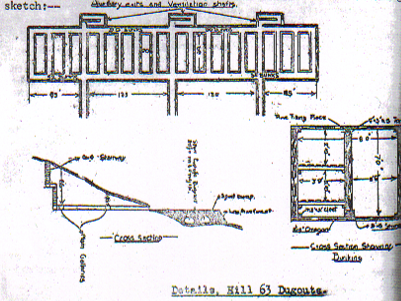
The underground workings were extensively timbered and included ‘rooms’ for officers and their batmen, designated bunks for runners and clerks, a large General Office, a Signals Office, a canteen, a small hospital and storage for electrical lighting and signals equipment. Particularly, it was well-ventilated with three exhaust fans (providing comfort for its occupants) and three entrances/exits (catering for any ground collapse in the event of enemy bombardment). Main passageways were signposed to encourage dual foot travelling while the main entrance was widened for a horse-drawn cart to deliver provisions and supplies. Nearly every soldier in the subsequent battle spent some time in the facility.
What made Woodward’s construction so every more special was that it was completed in only three months (significantly less time than the time planned), in wet unconsolidated ground and under constant enemy artillery bombardment with practically no injuries nor incidences.
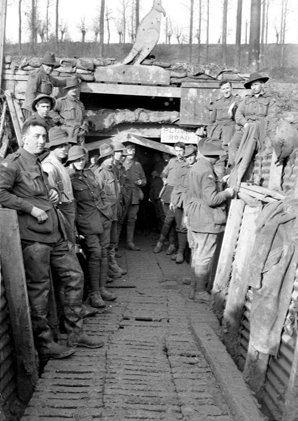
The facility was subsequently chosen by General Sir Herbert Plumer, Commander of the British 2nd Army, for its Command and Observation Post for the approaching battle. When performing the unveiling honours, he was accompanied by no less than 19 other Allied Generals, presenting an ideal artillery target for the enemy with so many ‘Red Tabs’ in one spot, not to forget the dozens of visitors and onlookers who popped in to witness the grand occasion. A decorated portal and a military band for background entertainment added to the ambience. A traffic jam on roads in the vicinity furthered the excitement.
After the festivity, the light-hearted Aussie tunnellers appropriately signposted the portal, ‘Plumer Road’ and proudly crowned their workmanship with a wooden kangaroo, fashioned from a piece of scrap boxing (see below). To both miners and military buffs alike, it’s probably the most recognisable ‘box cut’ of the Great War. And it’s quintessentially Aussie.
General Plumer was so impressed with the quality of Woodward’s work, that he and his Company were transferred to Messines Ridge to protect and ultimately fire the vital Hill 60 and Caterpillar Mines from an enemy determined to find them.
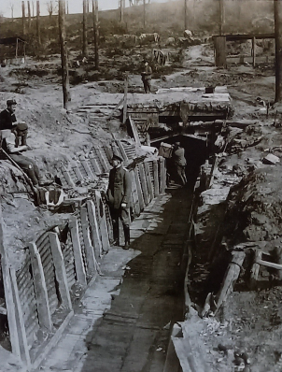
Similarly impressed with the well-established Hill 63 Dugouts was the enemy who briefly claimed ownership during the 2nd phase of the German 100 Hundred Days Spring Offensive in April 1918 (titled, ‘Operation Georgette’ ) led by Company Commander Karl von Dewitz of the 75th German Reserve Division in its failed bid to push the Allies to the English Channel. It wasted no time in repairing the faciliity after earlier bombardment by its own big guns and subsequent repurposing, but not before inverting the wooden kangaroo by accident or deliberate intention.
It was the discovery of this never-before-seen image, buried in Belgium military archives, that enshrined Woodward’s mining excellence ‘across the divide’ (see below).
It proved, however, to be the ‘last throw of the die’ for the tiring German Army which was forced to ultimately surrender and accept defeat with the signing of the Armistice on 11 November 1918.
Woodward, like most Australian tunnellers, returned home from the war as forgotten heroes, long after hostilities had ended, as they were engaged to help rebuild war-ravaged Belgium and France. He married his sweetheart, Marjorie Moffat Waddell on 3 September 1920 and recommenced his illustrious mining career where he had left off. He retired in his late 60s, settling in Tasmania and passing away peacefully at his home in Hobart on 24 August 1966.
But his Hill 63 Legacy lives on with an enthusiastic society in Belgium, presently clearing the legendary portal site with the aim of preserving its place in World history. Woodward and his tunnellers’ place.
He certainly did his County and Profession proud.
Ross Thomas is a retired mining engineer and noted historian on the Tunnellers. He is an Associate Member of the AusIMM Heritage Committee.
Click here to read more about Dr Sandra Close and Miriam Way visiting Miss Barbara Woodward.
Footnotes
i A specialist company, titled the Australian Electrical and Mechanical, Mining and Boring Company, often referred to the ALPHABET Company, was formed from the newly-created Australian Tunnelling Companies. This provided electrical and mechanical services to both Australian & British Tunnelling Companies during the war which included such vital services of power generation, pumping and ventilation.
ii Hill 63 was a strategically important position during the war due to its commanding views over the British-held area around Ypres in Belgium.