
Reshaping underground and deep open mine dewatering in Australian mines
As mines across Australia push deeper, the cost and complexity of dewatering continues to rise. Traditional pump stations in underground mining are typically constructed within large, excavated chambers where multistage pump sets or large progressive cavity pumps and extensive pipework are one of the most expensive and maintenance heavy parts of underground operations.
To simplify the site-wide dewatering setup and cut costs, operations can look to high head submersible pumps built for abrasive and high solids conditions. This article examines the application of Xylem’s Flygt 2450 as a case study in improving the efficiency and effectiveness of dewatering.
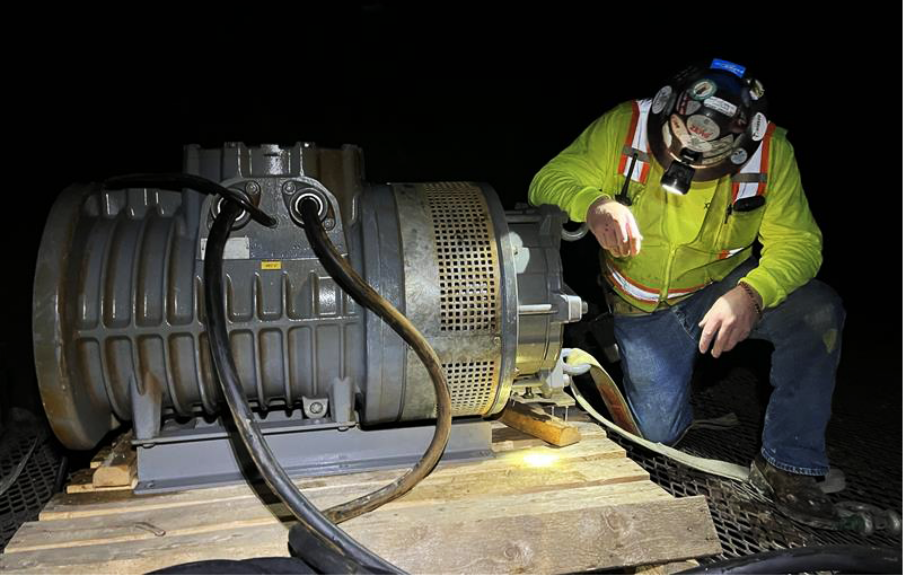
The Problem: traditional dewatering is too costly, too complex with large pump stations
Traditional pump stations typically demand several factors that make dewatering complex and expensive:
1. Large and expensive underground excavation
Conventional pump stations often depend on large excavations, substantial civil works and multiple associated infrastructure elements, all of which increase project complexity and engineering risk. From a practical safety and constructability perspective, reducing the size of the chamber and simplifying pipework and ancillary systems is a more controlled approach underground, particularly where operators are seeking to minimise excavation scope and permanent fixed infrastructure.
2. Multiple pumps, more failure points
Achieving high head normally requires multiple pumps in series or large progressive cavity pumps, driving up capital costs and complicating maintenance. Each additional pump represents another potential failure point, reducing system reliability and increasing the risk of unplanned downtime when something goes wrong.
3. Complex piping and sedimentation system
Traditional systems require separate sedimentation tanks, large manifolds and valve assemblies, long pipe runs, access platforms, steelwork, and concrete - all add layers of infrastructure.
4. Frequent maintenance interruptions
Wear accelerates in dirty water conditions, where many systems struggle with solids, leading to rapid impeller degradation and increased maintenance requirements. Frequent servicing, combined with difficult access, can result in lost production time, particularly for fixed installations that require disassembly or cranage.
The result of all these factors leads to high cost, low uptime and ongoing operational drag.
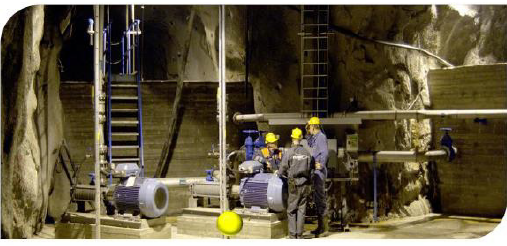
Single high head pumps can effectively simplify operations
Single high head pumps, like the Flygt 2450, replace entire multi‑stage pump stations with a single unit – significantly reducing cost, complexity, and infrastructure in both underground and deep open‑pit operations. The benefits of this approach include:
Significant infrastructure savings
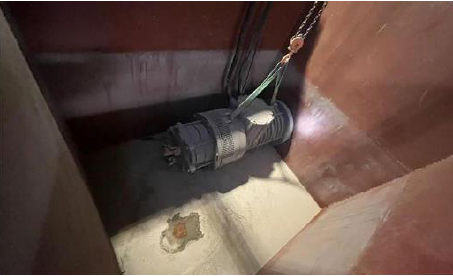
With a compact size (1.5 m high × 0.7 m wide) and hopper‑based installation, the 2450 removes the need for large chambers, sedimentation zones, multi‑stage pump sets and complex pipework. This leads to lower capital cost, faster installation, a smaller excavation footprint and far greater flexibility underground.
Lower maintenance costs through long service intervals
Extended 6,000‑hour inspection intervals reduce planned maintenance and callouts. When servicing is required, the 6‑bolt hydraulic access allows disassembly in under 15 minutes without heavy lifting or full teardown. This means lower labour costs, faster turnaround, and more uptime during production‑critical periods. It can also support a safer maintenance process by simplifying access and reducing the need for more complex intervention during servicing, which is an important practical benefit in underground mining environments.
Energy-efficient performance in harsh mine dewatering conditions
The Flygt 2450 is positioned as a high-head submersible pump engineered for the operating realities of mine-site dewatering, particularly where abrasive, high-solids water and long pumping distances place pressure on equipment performance and service life. Its mining-specific hydraulics are intended to reduce wear, prevent clogging and extend component life, while maintaining high hydraulic efficiency in sediment-rich water. Equipped with an IE3-rated motor and reported to handle solids concentrations of up to 10%, it is suited to harsh dewatering duties where both energy performance and solids management are important. A single unit can achieve a shut-off head of up to 300 m, where traditional arrangements may require two or three stages, with fewer moving parts, less pipework and minimal supporting infrastructure contributing to overall reliability and installation simplicity.
Reliability and uptime gains through simplicity
Every hour of downtime impacts production. A single high head pump reduces the number of components that can fail. With fewer moving parts, fewer pumps, less pipework, and minimal infrastructure, the system becomes inherently more reliable. For fast-advancing underground operations, portable, modular hopper systems add another advantage: they can move with the mine, rather than locking infrastructure into one place.
Table 1 Cost, Footprint & Efficiency Gains of Traditional Pump Station vs. 2450 Hopper Setup
|
Feature |
Traditional Dewatering |
Flygt 2450 System |
|
Excavation |
Large chamber |
Small sump/hopper |
|
Sedimentation |
Separate tank |
Integrated (basic) |
|
Pumps |
2-3 stages |
1 pump |
|
Pipework |
Complex |
Simple |
|
Mobility |
Fixed |
Portable/modular |
|
Maintenance |
Frequent |
6,000-hour intervals, fast access |
|
Head capability |
Requires pumping in series |
Shut-off head up to 300m from one pump |
|
Solid handling |
Limited |
10% solids |
|
Total operational cost |
High |
Lower |
Together, these improvements result in major cost savings across the full life cycle of the dewatering system - from installation through to long-term operation.
With significantly lower CAPEX, reduced maintenance, improved energy efficiency, and simplified operation, single pumps such as the Flygt 2450 help to cut costs, increase uptime, reduce infrastructure footprint, and improve overall operational efficiency.
Interested to know more? Contact the authors for more information on mine site dewatering.