
History and Heritage: The modern ferrous metallurgical revolution
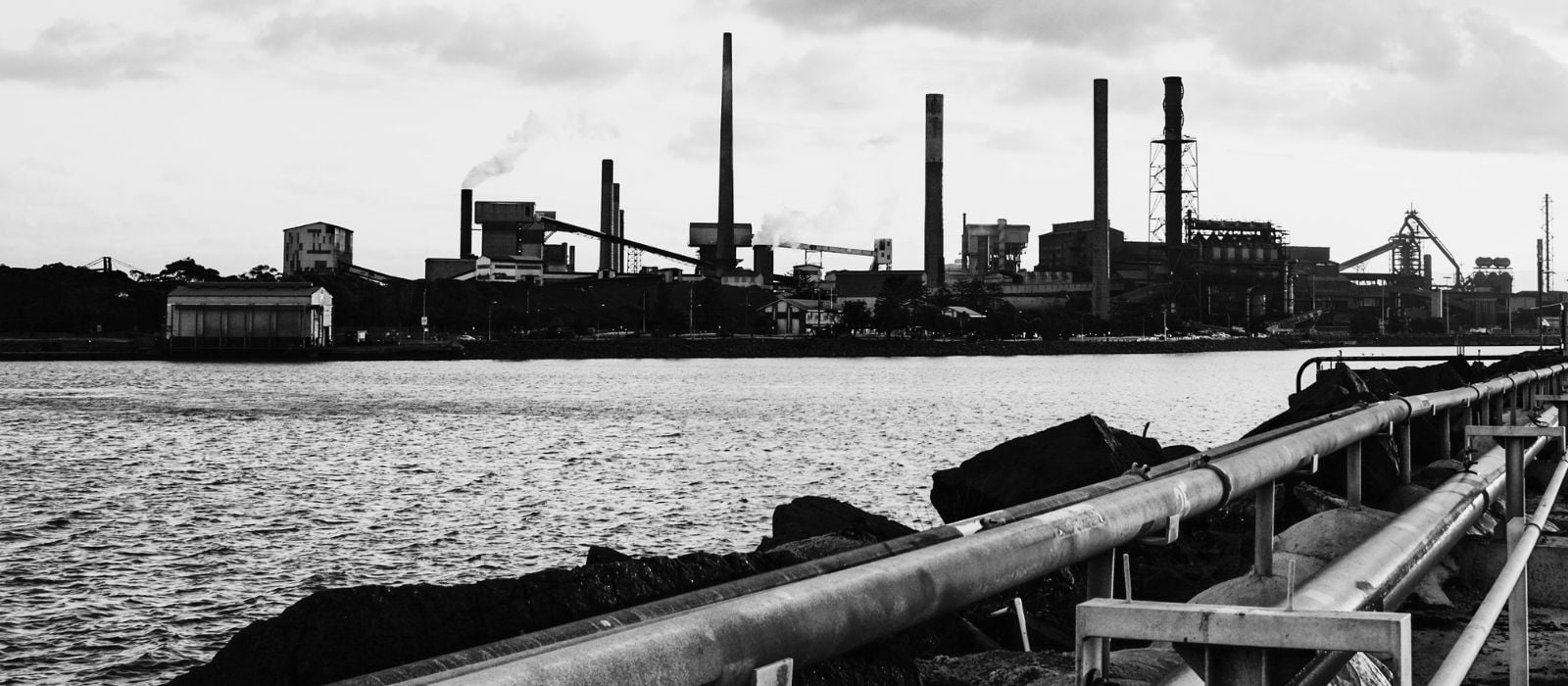
Image: AdobeStock.
This is an edited excerpt of a Presidential Address delivered at AusIMM's 1961 Annual Meeting in Melbourne.
As most of you know, my prime object in life has been concerned with steelmaking, so tonight you can ‘steel’ yourself to the thought that you are going to be spoken to about steelmaking.
Even if that were not the case, and were I not particularly interested in steelmaking, I think it would be appropriate to look at steelmaking in a broad sense on a basis of pure metallurgical interest, because the steel industry is going through as big a revolution today as it went through over one hundred years ago when Bessemer made a theory become a fact.
Bessemer, and as the Americans prefer to think Kelly, separately conceived the idea of blowing cold air through molten pig iron, and, contrary to the then general belief, this did not result in cooling of the metal but succeeded rather in heating it, and in burning out of the crude pig iron the impurities which prevented it from becoming a ductile metal.
For many years before this, steel had been made in a very small painstaking way by what was known as the crucible process. The output was small and the cost was high, which meant that steel was reserved for very specialised applications and was not available to other than the very rich.
With Bessemer, however, a revolution occurred which suddenly brought this very useful and most essential metal down to a price and a condition of manufacture which made it the basis of modern civilisation as we know it.
So, in 1856, there was a revolution in metals, and steel started its long upward climb to become the dominant metal of the 19th and 20th centuries.
Some few years after this, another brilliant set of intellects in Gilchrist and Thomas combined to refine certain of the Bessemer processes, and Siemens and Martin also developed a process where steel was made in the open hearths of an externally fired furnace. And so another new process was added to give greater impetus to the revolution in steelmaking.
Broadly, the position as far as steelmaking was concerned remained unchanged in basic principle until the end of World War II. Naturally there had been increases in the sizes of vessels and of furnaces, with refinements in operation, refinements in refractories, and refinements in the methods of firing. We at Port Kembla regard our plant as being almost a lineal descendant of the first steel furnace which produced steel in Australia.
Many of us at Port Kembla can remember certain of the old personnel who used to be on our open hearths, and who were present and assisted on that historic day in the tapping of the first open hearth steel in Australia 61 years ago.
However, the development in steelmaking, from the 4-ton furnace at Lithgow to the 550-ton furnace in course of construction today at Port Kembla, still left the metallurgical basis of operation unchanged.
So the time was ripe, I suppose, for a change in thinking – for a change in metallurgical development on the steelmaking side. But before we discuss this in any more detail we should look at another revolution which has done as much almost as Bessemer to change the standards of living. That revolution was on the rolling side and had its genesis almost 30 years ago at the Armco plant in Butler, Pennsylvania. A gathering of most ingenious engineers and mill operators fathered the prototype of what we now know as the continuous hot strip mill.
Previously, all flat steel products had been rolled piecemeal, and mainly in single sheets, by laborious manual handling, which was hard and expensive work. Hence sheet products were not available cheaply and freely, but there was, and it was realised at the time, a tremendous market potential available for those who could produce flat products by continuous mass production.
And so these pioneers at Butler started a revolution on flat product rolling which still has momentum today, although generally it would appear as if a static period has been reached in this development.
It is a very wise or a very foolish person who will say where a revolution ends, but for the purposes of our discussion we can accept the fact that flat rolled products have now reached as full an application in our civilisation as was expected, or probably more than was expected, at the time when this rolling revolution was put in train. Today we see the effects of that in our homes with stoves, refrigerators and television sets from flat steel; in the pipelines that service communities; in storage tanks, ships and rolling stock; and of course probably more important than anything else, we see the application of cheap flat rolled products to the motor car.
Now you might say, where does this fit into the revolution in steelmaking that I was proposing to tell you about? Well, it fits in this way.
Just as it was necessary to make flat rolled products to meet a potential market and that market came to be realised, there arose a demand for steel which was beyond the capacity of the existing plants to meet, and from the time of the early 1930s, when flat rolling became an actuality, up until now, there has been an·increasing demand for steel. There has been an almost insatiable demand that has led countries to insist on having their nationality embossed with the stamp of being a steelmaking nation; sometimes without regard to economic cost, but that is by the way. The facts are that steel has become a standard of our living levels.
So with this tremendous need of more steel production, the position was met by enlarging the existing units and building new ones on the same basis of even greater capacity. The revolution that changed steelmaking arose from the painstaking work of Professor Durrer in the thirties of this century when, in Berlin, he studied the use of oxygen in steelmaking on both thermal and metallurgical grounds. The application of this work became possible when the pioneering work of Frankl on the regenerative principle was taken up by the Linde Company in Germany and perfected as an economic tonnage process, and a new tool was put in the hand of the steelmaker.
It was not very long ago when oxygen was a sort of rarity that was mainly used for medicinal purposes. Now, when we think in terms of tonnage oxygen, we think in terms of plants which can handle air in such volumes as to produce anything up to 350 tons of gaseous oxygen in 24 hours. Naturally with such bulk production the cost of steelmaking with oxygen becomes competitive with other, older, methods. Even Bessemer, in his day, dreamt of the time when instead of using air, which has only slightly over 20 per cent oxygen, man would be able to blow the molten metal with 100 per cent oxygen with all the acceleration in the process that is inherent in the use of such high concentrations.
And so, in this century in which we live, this exciting century, there has been put into our hands a gas of tremendous potentiality and of very low cost. Thus the revolution in steelmaking has started, and every worthwhile steel industry throughout the world now is going more and more to the use of tonnage oxygen for the acceleration of its steelmaking processes.
We in Australia are no exception and all major plants now operating in this country, or plants that are in prospect, have as a prime base the use of oxygen as a steelmaking aid. Naturally, the steelmakers have developed a variety of methods of using this oxygen. I do not intend at this juncture to bore you with any detailed descriptions of how these processes work, but they all work fundamentally on the passage of oxygen through, or into, volumes of molten iron so that the impurities in the iron, or inbuilt fuels if you care to call them such, are consumed. By their consumption the iron is refined into steel and the metal temperature is raised to an appropriate value for teeming into ingots.
The first of the adaptations of this cheap oxygen was a sort of an upside-down Bessemer process. While Bessemer blew a blast of nitrogen contaminated oxygen – the air that we normally breathe – in through the bottom of his vessel, the first real pioneers of the new oxygen steelmaking process blew oxygen into the top of the vessel. They used a water-cooled lance to make the stream of oxygen impact at high velocities on to the liquid surface of molten pig iron, which was contained in a bottle-shaped refractory-lined container rather reminiscent in shape of the Bessemer converter.
This became known as the L.D. process which, after some discussions, has now been accepted as being christened after the two centres in Austria where the process was primarily developed – Linz and Donowitz.
This new method of steel making, which increased the output rate of steel some fourfold as compared to the older, conventionally fired furnaces, also of course made a steel free from the nitrogen contamination which imposed some limitations on the use of Bessemer or Thomas steels.
There were obviously certain reservations in respect to the L.D. method. Some of them were of a thermal nature in that the full utilisation of the carbon in the charge was not made, as the temperature at which the carbon united with oxygen was in an equilibrium range which made it impossible for the carbon to burn fully. Carbon was only burnt to carbon monoxide which did not burn inside the vessel but which escaped to burn in the air above and consequently wasted potential heat which could have been used in the process.
Naturally there was a development from this, and this had its genesis in the thought that there should be some means of burning with economic gain the gases which were evolved during the actual reaction between the metal and the oxygen. A process broadly known as Kaldo was produced and this consists of a sort of Y piece going into a bottle-shaped vessel lying on its side. One line conducts oxygen into the metal where the normal reactions of the L.D. take place, and the other extension blows oxygen above the level of the liquid surface and burns the CO that has developed into CO2 inside the vessel where almost adiabatic conditions obtain, and tremendous heat developments are possible. Such heat indeed that it is essential in order to preserve the refractories in the vessel, for the vessel to be rotated, which thus creates the rather odd situation that liquid steel is used as a coolant.
There were a number of variants on these two basic oxygen processes, and we have other processes known as the Rotor process and the like, but fundamentally these two direct oxygen methods are the basis and the others are broadly refinements. There are such developments as injecting finely ground lime in with the oxygen stream to make for rapid sulphur purification within the vessel, but broadly the fundamentals are as for the L.D. and Kaldo processes for direct oxygen steel production.
This of course meant that the majority of steelmakers, who had been pinning their faith on the accepted open hearth method, had a tremendous volume of capital which could at first sight seem redundant because of these new methods of direct blowing into molten metal. Hence there was a vital interest in the use of oxygen blowing in such a way as to allow the benefits to be incorporated in existing open hearth installations.
The open hearth has its drawbacks, and as a thermal unit it is not outstandingly efficient, but economically it has some advantages which are denied to some of the direct oxygen processes.
It has the ability, or shall I say the versatility, to accommodate itself virtually from 100 per cent molten charge to 100 per cent solid cold charge, and so it has a tremendous use in the variations which occur from time to time in an integrated steelworks. When blast furnaces are brought down for repair, either by accident or design, then the open hearth is a very versatile instrument in the steelmaker's hands.
Similarly, as works become more integrated and go more towards the finished products, there arises more return scrap. This applies particularly in those works where flat products are a main output. So there is a bigger circulating load of internal cold scrap, and again the open hearth can demonstrate its versatility in accommodating itself to these variations in charge constitution.
At this stage we in Australia are now following behind some of our compatriots overseas in that we are still accumulating experience. But, as I said earlier, the basis of steel expansion in Australia, at whatever centre is in mind by our Company, has as its main consideration, the utilisation of oxygen as a main steelmaking aid.
The experiments which have been made in the open hearth process have started to show tremendous promise, and it is not too much to expect that in the next few years the open hearth will be developed to retain its versatility in its ability to accommodate wide varieties of charge constitution and yet be able to make steel at hourly tonnages comparable with the other more direct oxygen steelmaking methods.
Certain of our officers have recently returned from overseas where they have seen in some of those countries tremendous advances in the use of oxygen in open hearth furnaces. When I mention that one of those officers was Mr I M McLennan you will understand that we are taking a very sharply increased interest at the various steel centres in New South Wales in the use and application of oxygen to open hearth developments.
That, I think, can be said to be a very rough summary of this revolution which has taken place in steel metallurgy in the last decade. Like most revolutions, it will probably produce in its full flowering a lot of possibly unexpected results, which at the moment are not evident to those of us most directly concerned with this change in thinking. But there is no doubt in my mind that whatever the process used for making steel, be it by direct oxygen blowing, or be it by adaptation of the open hearth, there is in the next few years going to be a tremendous change in the fundamental thinking of steelmaking. The open hearths of the future may bear little or no resemblance to the open hearths of today. The economics of using fuel in the way that we do in present open hearths, and the practice of building tremendous heat exchangers at the end of the furnace, could possibly be modified by the time this revolution has gathered full speed.
All these things are still in their veritable infancy but no matter where the development ends, there is no doubt that those of us who are in the steel industry today are engaged in as big a revolution in the manufacture of steel as was engaged in by those pioneers of steel who followed in the footsteps of Sir Henry Bessemer.