
Measuring friction on haul roads: reducing risk and unlocking operational savings
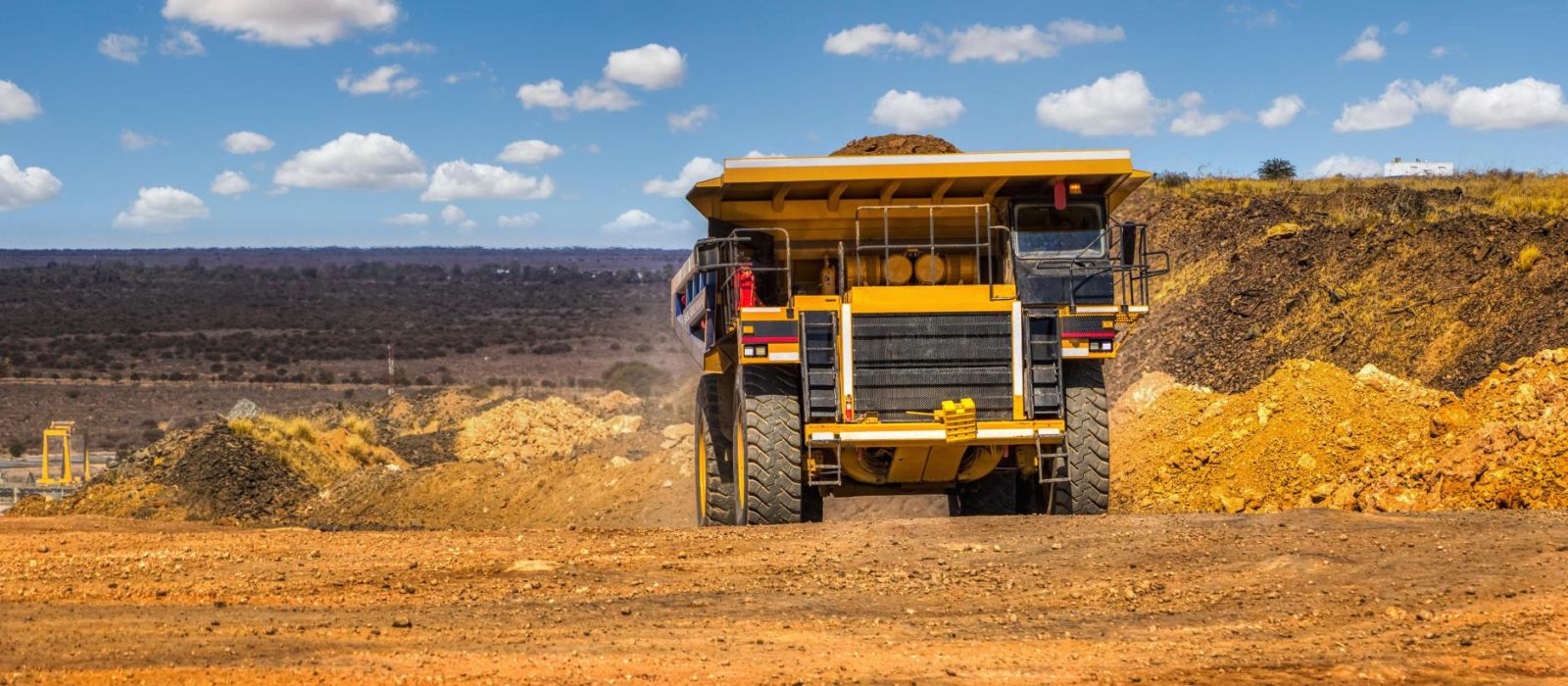
In some way, shape or form, mining haul roads play an important role for all resources professionals.
Whether that be from a safety perspective, with haul roads designed to minimise risks and keep operators out of harm’s way; or an operations point of view, maximising traffic flow leading to a higher tonnage output mine; or perhaps you have one eye on the financials and are managing capital equipment, maintenance and equipment longevity. Put simply, the haul road is the lifeblood of mining operations and friction, a completely measurable dataset, is the key to all of the above.
What is friction?
Friction measuring has been around since the earliest days of engineering. Leonardo da Vinci was experimenting with it centuries ago. Understanding haul road friction can sometimes leave you a little dusty (pardon the pun!), but the good news is these days there are good measuring tools – coupled with good science and expertise – that assist managers and operators to utilise this data and make informed decisions.
Measuring friction is not isolated to the mining industry. In fact, it plays a crucial part in the packaging industry. In this context, optimal material slip resistance to grip is measured, assisting with preventing operational issues such as machinery jams. The metal forming industry measures friction during the metal forming process in order to assist with optimal tool life design. The automotive and aerospace industries use Coefficient of Friction (COF) testing to assess performance of materials in automotive braking systems to quantify the ‘grip’ or resistance between road surfaces, effectively measuring the maximum braking or accelerating force between tyres and the road without slipping.
Friction in the mining industry
In specific relation to measuring friction on mine sites, this article sheds light on a few of the tools available and looks at some of the correlations to data that will assist you.
It is important to pause for a moment and understand that the purpose for testing friction is a direct result of dust. A dry haul road that is disrupted by machinery or wind can move dust throughout the atmosphere. This creates a visual hazard and is a safety issue for workers and nearby communities as well as fragile ecosystems. Dust contamination has been linked to serious illness and diseases such as silicosis as well as contaminating waterways, flora and fauna. The EPA takes the migration of dust extremely seriously through monitoring mine sites and neighbouring communities, holding operators accountable through financial penalties in the form of large fines and mine shutdowns.
The introduction of water to suppress dust, in theory, is the solution to the problem – but this is where things can get a little complicated. If not enough water is used, dust won’t be suppressed appropriately. On the other hand, over-watering creates a hazard in the form of loss of traction.
There is a raft of information to sift through, but let’s start with some of the key points. It is also worth noting that beyond preventing incidents, friction data also helps operators make better decisions about road design, dust suppression and productivity.
The obvious downsides to low friction include:
- unplanned movements (e.g., trucks sliding)
- serious equipment damage
- costly downtime
- severe injury or fatality risk.
When it comes to measuring friction to assist with haul road design and maintenance, the following considerations come into play:
- validating slope and ramp profiles against available traction
- confirming camber and crossfall against targets
- comparing sheeting materials to maximise grip
- assessing grading techniques and their impact on traction
- checking curve radius suitability for expected speeds and loads.
The following should be considered when measuring water cart efficiency (i.e. achieving dust suppression without over-watering):
- finding the right amount of water to control dust without creating an unnecessarily low friction surface. There is evidence to suggest that most water cart operators that manually apply water will over-water. It is a fine balance between introducing water to suppress dust but not over-watering, which lowers friction.
- Reducing water usage where supply is constrained.
- Lowering diesel consumption by avoiding unnecessary watering runs.
- Reducing lost time at fill points and improving cycle efficiency.
- Decreasing wear on water cart components through better targeting.
Properly considering friction can also raise the bar with your site safety awareness, by using this data to assist you with developing safety protocols. For example, a lower friction result could at least make your drivers aware of some of the more challenging sections on their haul roads or even assist you to bring in real-time speed restrictions in a timely manner after weather events.
Measuring friction can also be used for recording and reporting purposes in the unfortunate event of an unplanned vehicle movement.
Testing and measuring friction
Testing and measuring friction on mine sites is not as common as you would expect. Two available options include Australian Diversified Engineering’s ADE Friction App, which assists machine operators to measure COF quickly and easily via a mobile device helping make smarter decisions on exactly how much water should be applied. Another measuring device on the market is produced by Vericom. Vericom’s journey in the field of measuring devices began in 1984 with the development of the first electronic accelerometer. Their equipment is used in a wide variety of applications from automotive to aerospace.
The two below figures give an insight on how the friction measurement (whether it be recorded via the ADE Friction App or Vericom unit) starts to translate into meaningful data.
Figure 1 outlines the “Tulloch/Stocker Friction Model”. Essentially, a higher COF result yields a healthy green normal safe operating range for vehicles; conversely, a lower friction result begins to provide cautionary advice.
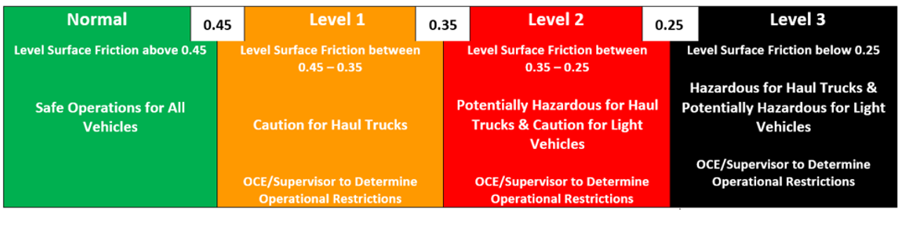
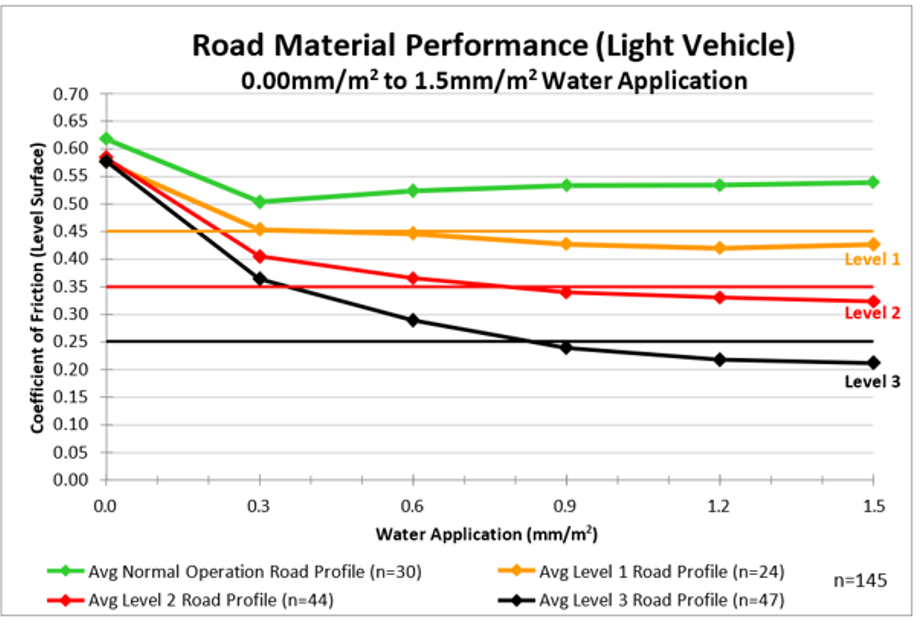
Figure 2 provides an example graph of COF (Y-axis) versus water application (X-axis). A decreasing COF can clearly be seen as water build-up increases. With a metered and measured watering system you can see how friction measuring technology can assist with setting optimal water output.
> 0.45: Safe operations for all vehicles.
0.35 – 0.45: Caution required for haul trucks.
0.25 – 0.35: Significant safety risk; operational restrictions needed.
< 0.25: Extremely hazardous.
Irrespective of what method is used, the next part of the puzzle is how you make use of it to assist in your daily operations. Here is a brief overview of the main principles:
- Firstly measure (in wet and dry conditions, with various build-ups of water) your key haul road sections to get a good baseline of what ‘good/available dry conditions’ friction is.
- Set friction targets/thresholds for key road segments (ramps, corners, approaches).
- Define a simple test cadence (eg after grading, after rainfall events and on a routine schedule). Embed actions into haul road and dust suppression SOPs (i.e. what to do when results fall below target).
- Train operators and supervisors on consistent testing technique and interpretation. Capture results in a shared log for trending, audits, and continuous improvement.
Both of the measuring tools discussed above will give you an accurate measurement, however it is up to your site to decide which tool is right for you.
Want to know more?
If you’d like to further discuss how friction measurement could fit into your site’s haul road and dust suppression routines, please contact the author.