
Obituary: John Murray Allen
John Murray Allen, BSc (Hons) (Otago), MSc, PhD (Queen’s, Kingston) FAusIMM (1987), SEG (1993) | 23 May 1943 – 11 November 2023
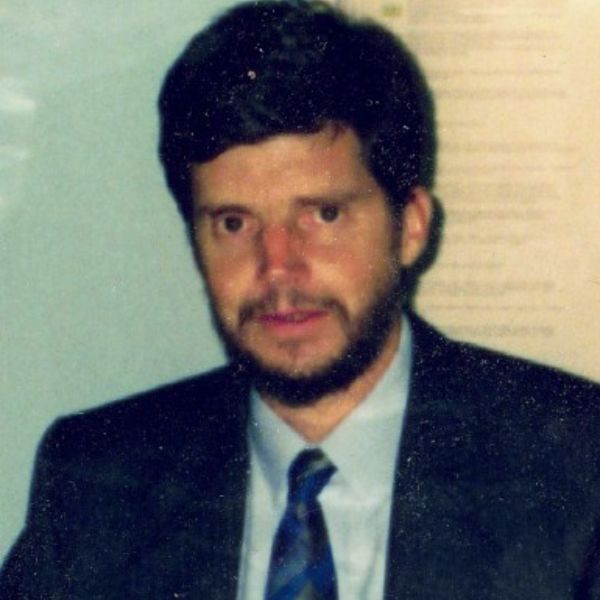
In Vietnam, c. 1990. Photo: Allen family.
John Allen, consulting geologist, died on 11 November 2023, aged 80. His career of almost 50 years took him from metamorphic petrology and meteorite research in North American universities to mineral exploration across New Zealand, Vietnam, Indonesia, China, Tibet and Mongolia. He was a quietly spoken and exceptionally thorough geologist whose considered opinion was sought out, and acted upon, by those who worked with him.
Early years and education
John went to school in Dunedin, Gore and Wellington. At Wellington College he proudly avoided team sports, preferring to hike and hunt in the Tararua Range. After a year at Victoria University, he worked as a technician with the DSIR Geophysics Division, travelling throughout New Zealand on the national gravity survey, before returning to Victoria to study geophysics and geology. In 1965 he transferred to the University of Otago, where he met Donna in the Geology Department library. They married in 1967; the year he graduated BSc (Hons).
Canada and the United States
At Queen’s University in Kingston, Ontario, John completed an MSc (1971) under Hugh Wynne-Edwards on Precambrian uranium deposits and the Mont Laurier pegmatites. He then joined Dugald Carmichael’s metamorphic petrology group, graduating PhD in 1976 with a thesis titled Silicate–carbonate equilibria in calcareous metasediments of the Tudor Township area, Ontario.
After a year at McGill University, John joined Lawrence Grossman at the University of Chicago in 1978 as a postdoctoral research associate, working on meteoritics. His mineralogical and petrographic studies of refractory calcium–aluminium-rich inclusions in the Allende meteorite, including the isotopically unusual hibonite-bearing inclusion known as ‘HAL’, were carried out with Gerald Wasserburg’s group at Caltech and published in the Proceedings of the Lunar and Planetary Science Conference (1978, with Grossman, Andrew Davis and Ian Hutcheon) and Geochimica et Cosmochimica Acta (1980, with Grossman, Typhoon Lee and Wasserburg). Wasserburg’s address on the 1980 paper is, memorably, the ‘Lunatic Asylum’, the tongue-in-cheek name of his world-leading Caltech isotope laboratory (its custom-built mass spectrometer was about 30 times more precise than earlier instruments), which dated the Apollo lunar samples and found evidence in Allende inclusions that a supernova contributed to the early solar system. John also worked on some of the early lunar samples. In 1979 he returned to teaching at the University of Toronto. There he published an experimental study of zoisite stability with J J Fawcett, researched tanzanite and began consulting, notably for the newly formed Barrick Resources (later Barrick Gold).
Consulting in New Zealand and Asia
The birth of their daughter Emily in 1985 prompted a return to New Zealand, and the family settled in Devonport, Auckland, where their son Timothy was born in 1989. Toronto friends thought John brave to go home without a job; he joked that he would grow kiwifruit. Instead, he arrived in a mining boom and set up Allen Geological Consultants, re-evaluating historical goldfields in Northland, Coromandel, Westland and Marlborough and assessing the gold–silver potential of the Taraire breccia pipe at Kaeo.
With two colleagues, Terry Leach and Anthony Coote, at Chartered Mineral Services Ltd (CMS), John evaluated the rich Ban Phuc nickel deposit in Vietnam at the invitation of the Vietnamese Government, and as lead negotiator for their company, Asian Mineral Resources, found he enjoyed and excelled at dealing with officials. He worked there for about four years when, in the first year, the only link home was a telex machine at the Hanoi Post Office.
From about 1991 John worked regularly for Freeport Indonesia at the Ertsberg–Grasberg district in Papua, and later in Kalimantan, through his own firm, John Allen and Associates Ltd, based in Devonport.
From about 2005 John supervised drilling at Ross Turner’s Ikh Salaa copper prospect in Mongolia, a country he loved and kept returning to despite several attempts to retire. As Exploration Manager for South China Resources, based in Xi’an, he oversaw molybdenum drilling and made two extended trips to Tibet to assess copper prospects. Back in New Zealand he prospected for gold, platinum and lithium.
The geologist
John was thoughtful and understated, almost shy. He preferred to work alone, but once he had done the work his opinion was highly valued and acted upon. On one project in China, after considerable problems, frustration over reconciling assays with sampled rock faces and core, John went back to the original records. He, with the assistance of a local technician, laid out the old level plans, all in Mandarin, with the original assay sheets across a large room. He eventually showed that a majority of the reported grades matched the original assays only if the decimal point was moved one place to the left: the true grades were an order of magnitude lower.
John’s academic publications were relatively modest in number, but their scientific quality was high. His reports for industry were far more numerous, and reflect his long career as a consultant. John was a Fellow of the AusIMM and, from 2000, a Chartered Professional (Geology), an accreditation he let lapse when he retired. A member of the Society of Economic Geologists from 1993, he was recognised in 2018 as a Twenty-five Year Member and ‘Distinguished Representative of the Economic Geology profession’. In 1998 the Geological Association of Canada’s Mineral Deposits Division awarded him the Julian Boldy Certificate for the best mineral deposits paper at its Annual Meeting in Quebec City.
Beyond geology
Donna recalls that John’s work in mineral exploration was driven mainly by economic necessity; his deeper interests were volcanology, seismology and palaeontology. Auckland itself sits on 53 volcanic centres, and he visited others including Mount Yasur on Tanna in Vanuatu and several along the Indonesian archipelago. He followed seismic activity worldwide, and the family made fossil-collecting trips around New Zealand. My wife Diana and I first met John and Donna in Toronto. Diana had met Donna about a year earlier, soon after we arrived in Canada. When we returned to Toronto in 1985 from a nine-month stint at the Woods Hole Oceanographic Institution MA, a couple of weeks before our first child was born, John and Donna kindly put us up in their attic bedroom while we searched for a place to rent, a kindness we have never forgotten, and we have remained good friends ever since.
John and Donna sailed their keelboat Mollymawk on the Hauraki Gulf from 1994. During a lull in consulting John wrote, illustrated and self-published the New Zealand Marine Radio Handbook. It ran to three editions (2003–2009), sold more than 5000 copies and was used in Coastguard Boating Education courses. He loved travel, art, reading, conservation, birds and the history of religion, particularly Buddhism, and was an excellent photographer and writer. Accounts of his travels and a family genealogy remained unfinished.
John is survived by Donna, their children Emily and Timothy, and grandchildren Enda, Rosalie, Ray and Jaxon.
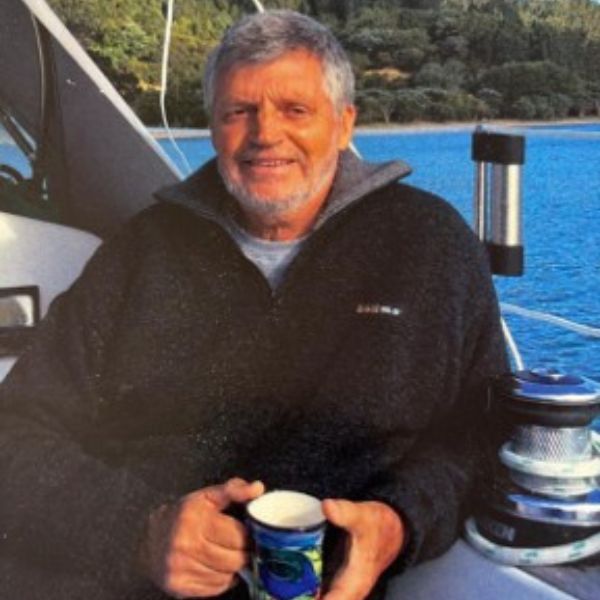
John Allen aboard Mollymawk, c. 2021. Photo: Allen family.
Selected publications
- Allen J M, Grossman L, Davis A M and Hutcheon I D, 1978. Mineralogy, textures and mode of formation of a hibonite-bearing Allende inclusion. Proceedings of the 9th Lunar and Planetary Science Conference, pp 1209–1233. Pergamon Press.
- Allen J M, Grossman L, Lee T and Wasserburg G J, 1980. Mineralogy and petrography of HAL, an isotopically-unusual Allende inclusion. Geochimica et Cosmochimica Acta, 44(5):685–699. Pergamon Press.
- Allen J M and Fawcett J J, 1982. Zoisite–anorthite–calcite stability relations in H₂O–CO₂ fluids at 5000 bars: an experimental and SEM study. Journal of Petrology, 23(2):215–239.
- Allen J, 2003, 2004, 2009. New Zealand Marine Radio Handbook, 1st–3rd editions (self-published, Auckland).