
Exploring Iron Ore - AI in Iron Ore Mining
Benefits
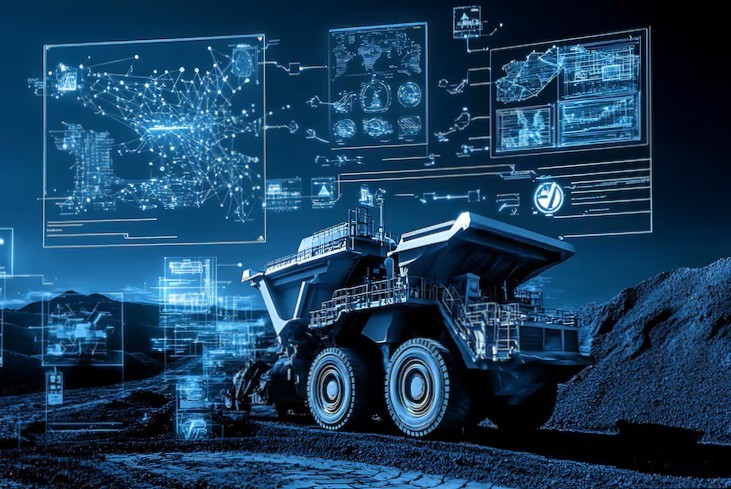
Mining of iron ore generates large amounts of data, such as from automated haul trucks, trains, drills and assay laboratories. The scale and complexity of data are too much for humans to handle and machine learning is needed to handle it. AI can reveal complex patterns and relationships. Predictive analytics can be used to determine optimal times for equipment servicing and parts replacements before breakdowns. Equipment monitoring is constant and more accurate using real-time internet of things (IoT) data and AI.
AI allows scalability for data processing and analysis. Cloud platforms give access to technology and processing power beyond local machines and allow a higher level of capability. Processes can be automated and run on streams of data as it arrives, rather than being acted on manually only at certain times of the day.
AI methods may be used to solve a wide range of problems. For example, computer vision is applicable to oversize rocks in ore bins, spillage from conveyors, leakage of water from tailings dams, and hyperspectral scanning of minerals in active mining faces and pit walls in open cuts. Normative mineralogy of iron ore can be calculated from chemical analyses.
Natural language processing (NLP) can be used to summarise shift logs and drilling reports, questions and answers of documents stored in knowledge databases, and topic modelling of clusters from records of safety incidents.
Challenges
After testing AI at a test minimum viable product stage, moving AI to the production stage requires a large investment in time and resources to get set up and maintain. Demonstration of ongoing business value is required to justify investment. Significant cloud, server and computational resources may be needed. Algorithms may be run on cloud resources rather than local machines. Deep learning models require GPUs, which are run from the cloud or dedicated servers.
Finding people with AI skills for the Western Australian iron ore industry can be a challenge. There are increasing numbers of junior developers available for AI applications, but these are unlikely to have mining experience. The largest concentration of AI companies in Australia is in Melbourne, far from the iron ore industry. The main concentration of mining related AI companies in Australia is in West Perth. There are also small startups in Perth working on mining related AI, such as autonomous agentic AI, NLP for mineral exploration open file reports and exploration targeting.
Expectations of management must be realistic, as current AI is narrow and targeted for narrowly defined scopes, rather than general. AI needs to be correctly set up, maintained and is tailored to the problem to be solved, rather than being general. There is often scope drift when working on an AI project, and scopes must be well defined. AI models must be monitored during production, as changing conditions such as mining different areas of the orebodies can result in the model predicting on data outside its training dataset.
Advanced machine learning models may have the highest accuracy if there is sufficient training data, but this is at the expense of explainability, and a model becomes a black box.
The algorithms are only as good as the data they are trained on. A model predicting rare events, like equipment failure, must have sufficient examples of breakdowns that the model can be trained to recognise these failures. A model predicting multiple classes must have sufficient examples of each class in the training dataset. Machine learning datasets must be carefully labelled and curated. Labels must be checked if this work is outsourced to an established labelling company. Labellers are unlikely to have experience with iron ore data, and this work may have to be done in-house.
Huge amounts of power and water for cooling are used by the large data centres that run AI models by companies like Amazon, Google and Microsoft.
Internet bandwidth and connectivity constraints at remote mines makes it difficult to send data to cloud-based servers for processing and getting results back. Internet connections can be intermittent, reducing AI reliability. Latency prevents real-time answers from AI systems. Solutions include using edge computing, offline models and model optimisation and compression.
Conclusions
The use of AI in iron ore mining has already yielded great benefits in efficiency and cost savings. However, its use is at a relatively early stage, and many potential benefits remain to be explored. Talks at events like the AusIMM Iron Ore | Open Pit Operators 2026 allow advanced methods to be given exposure and discussed.