
Structure before statistics: reducing geological uncertainty in resource models

Executive summary
Mineral Resource estimates underpin investment decisions, mine planning and corporate valuation. However, many significant resource downgrades arise not from sampling or geostatistical errors, but from shortcomings in the geological model itself. This article summarises the key lessons from a paper by Reid and Cowan (2023), which won the Geological Society of Australia’s A. B. Edwards award for best economic geology paper published in the Australian Journal of Earth Science, Volume 70 (2023). The paper (Towards quantifying uncertainties in geological models for mineral resource estimation through outside-in deposit-scale structural geological analysis) is open access and freely available for download, so this article will not reproduce the entire paper but, rather, highlight the key learnings. Reid and Cowan (2023) demonstrate how deposit-scale structural interpretation of drill-sampled grade data can materially reduce modelling uncertainty before resource estimation begins, resulting in a more robust, geologically based resource estimate.
Geological models, not statistics, are often the weak link
Evidence across the industry shows that many downgrades stem from incorrect domain geometry, unrealistic continuity assumptions, and implicit modelling artefacts (Reid and Cowan 2019, Sterk 2019, Stoch et al. 2022). While statistical estimation inside domains is typically robust, errors introduced during geological interpretation propagate directly into tonnage and grade outcomes. If the geology is wrong, the resource estimate will inevitably be wrong.
This is not a new issue, nor one specifically related to the use of new implicit modelling tools. In fact, the primary example in Reid and Cowan (2023) shows a significant geological-domain issue in an explicitly modelled estimate. The issue lies not in the methodology employed, but rather in the lack of geological first principles applied to the geological model. Poor linkage between what is observed on screen and what is possible under the prevailing geological conditions at the time of mineralisation deposition. The geological model must meet expectations for deposit formation under the prevailing conditions. If the model looks correct but is not explainable by the expected deposition model, perhaps the original premise about the deposit is wrong and needs re-evaluation.
Structural controls are detectable in routine grade data
Grade distributions inherently record the structural architecture of mineral systems. Folds, shears, faults and lithological contacts can often be recognised directly from drill-hole assays. Consequently, valuable structural insight can be extracted even where formal structural measurements are limited or absent.
It must be understood that the deposit reflects the underlying geology and the chemical and physical conditions at the time of deposition. The distribution of grade will vary according to the underlying lithology, oxidation states of the primary mineralogy and the structural architecture. For example, a deposit may appear folded when, in fact, it is simply stamping itself over a previously folded terrane; a deposit may appear sheared when, in fact, it is only replacing an underlying sheared fabric. Cross-cutting structures need not define “cutting planes”; they may instead be preexisting structures that define Perkins Discontinuities (Cowan and Hobbs 2024, 2025). These small-scale observations are important for understanding the history, the geological foundation, and, ultimately, the geological and structural architecture of the deposit. This ultimately defines the estimation domains informs the resource estimate.
Axial symmetry provides the primary constraint
Most deposits exhibit a dominant continuity direction, typically a plunge or elongation axis, which is structural in most cases. Identifying this symmetry dramatically reduces the number of geologically plausible model configurations. By constraining orientation early, the modelling problem shifts from an infinite range of possibilities to only a small number of defensible outcomes. These outcomes can then be assessed to reduce the number of options and, if necessary, modelled. Generating a multitude of estimates using varying parameters to assess “plausible outcomes” is a significant amount of largely unnecessary work and is similar to a blindfolded exploration geologist throwing darts at a map and exclaiming “target generation”. There are only a small number of plausible deposit geometries possible under a given set of deformation conditions. Understanding the underlying geology and stress at the time of mineralisation reduces these geometries to a handful, and assessment of axial symmetry further reduces them. This is best summarised in Figure 1 where a series of synthetic models were produced using multiple drilling patterns and based on the separate premises – isotropic (1b), isotropic with surface contact trace (1c) and anisotropic with plunge modelled and a contact trace (1d). It is evident that when geological context is applied to the model, regardless of the drill direction, the model is always the same, showing that there are realistically few alternative options to the model geometry.
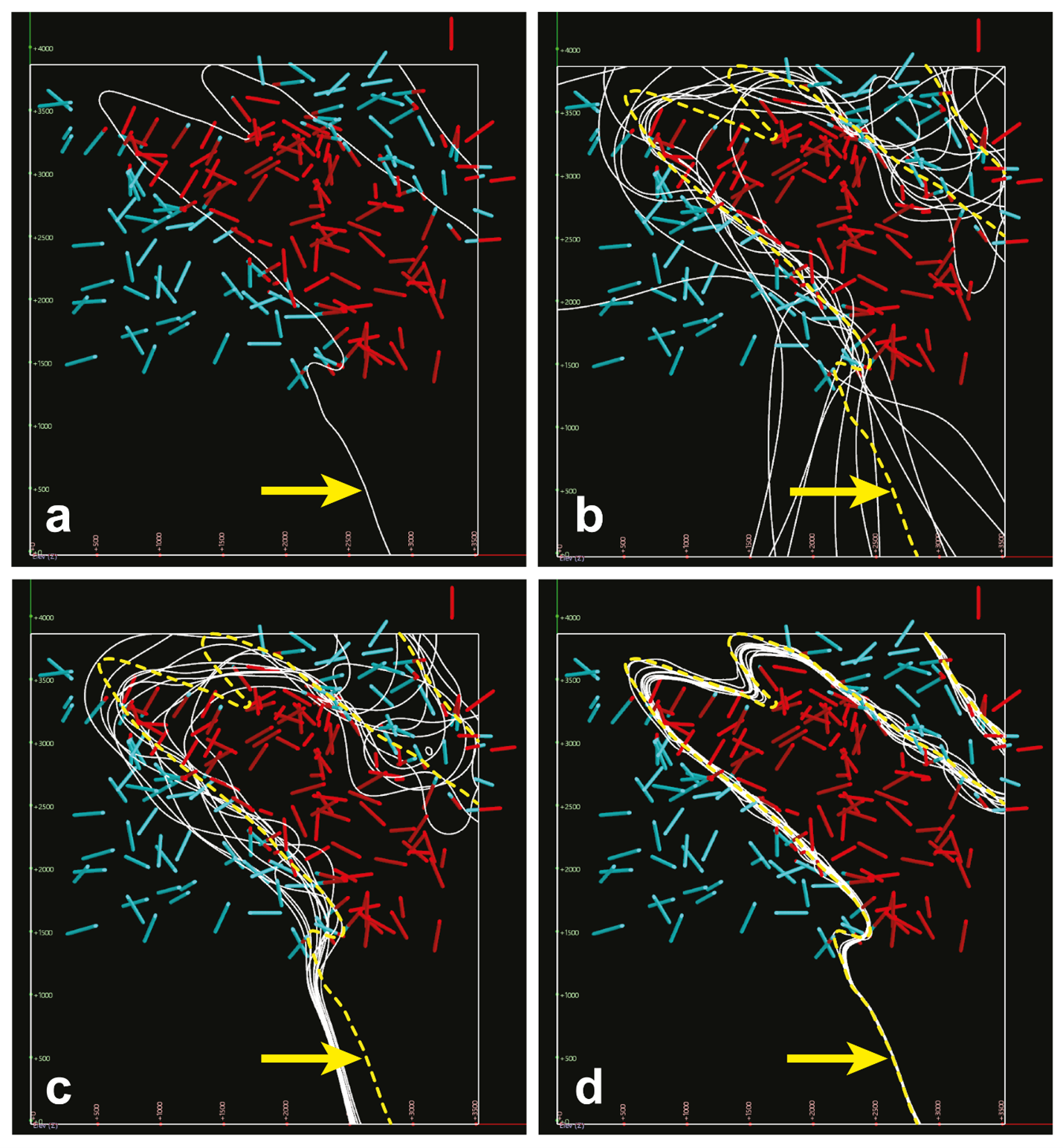
Figure 1. a) A horizontal sectional slice located at the base of a synthetic model developed to test the impact of modelling using asymmetry. The traces of 11 models produced for several series based on 1) isotopic search with no surface contact, 2) isotropic with surface contact mapped, and 3) anisotropic with down plunge search and contact trace and are displayed in Figures 1b, c, and d, respectively. The arrow in the figure indicates the trace of the lithological contact from the synthetic model (a), all drill hole segments are depicted in these sections.
Maximum Intensity Projection (MIP) enables rapid interpretation
Maximum Intensity Projection (MIP) provides a fast, visual method for identifying down-plunge trends within dense or sparse drilling datasets. When combined with interactive rotation of grade points, structural continuity and any axial symmetry becomes immediately apparent, allowing consistent interpretations between practitioners and improving reproducibility.
MIP should be integrated into all Exploratory Data Analysis (EDA) processes for resource estimation, as it will assist not only in identifying axial symmetry and the direction of continuity, but also in identifying likely High Grade (HG) domains, search ranges, and the most likely variogram axes. MIP gives the modeller instant visual feedback on likely continuity and metal distribution.
Common industry practices can introduce bias
Traditional vertical sections, fence drilling, and blind isotropic implicit modelling may unintentionally impose incorrect or misleading geometries. Traditional sections do not describe the true deposit geometries (Cowan 2016). Fence drilling normal to strike was originally designed to allow vertical sections to be hand-drawn for volume and average grade calculations and has no bearing on the robustness of an estimate; it can result in biased estimates, and in the age of modern 3D modelling, it is a completely unnecessary practice.
Blind, isotropic implicit modelling is occasionally presented as an unbiased way to assess a deposit. However, this argument fails on fundamental grounds: the deposit was not formed in a blind, isotropic manner.
These approaches can create artificial continuity, inflate volumes and increase the risk of later downgrades. Geological plausibility should therefore precede automated interpolation. Only once the underlying geological controls on a deposit are understood, and the few plausible outcomes described, can the true deposit geometries be modelled?
The Outside-In structural workflow
Reid and Cowan (2023) propose an alternative workflow termed the Outside-In structural workflow. The workflow comprises the following steps: first analyse raw grade data, then determine structural trends, build form surfaces, construct domains aligned with structure, and only then perform geostatistical estimation. This sequence ensures that estimation is applied to geologically meaningful volumes rather than statistically valid, but geologically improbable ones.
Demonstrated case study benefits
The paper presents an application of the workflow to a historical WA gold deposit (Figure 2). The study steps through the modelling process, questioning and introducing the geology into the workflow and revealed previously unrecognised folded controls on mineralisation and highlighted new exploration targets. The results illustrate that improved geological understanding can both reduce resource estimate risk and whilst also creating opportunity.
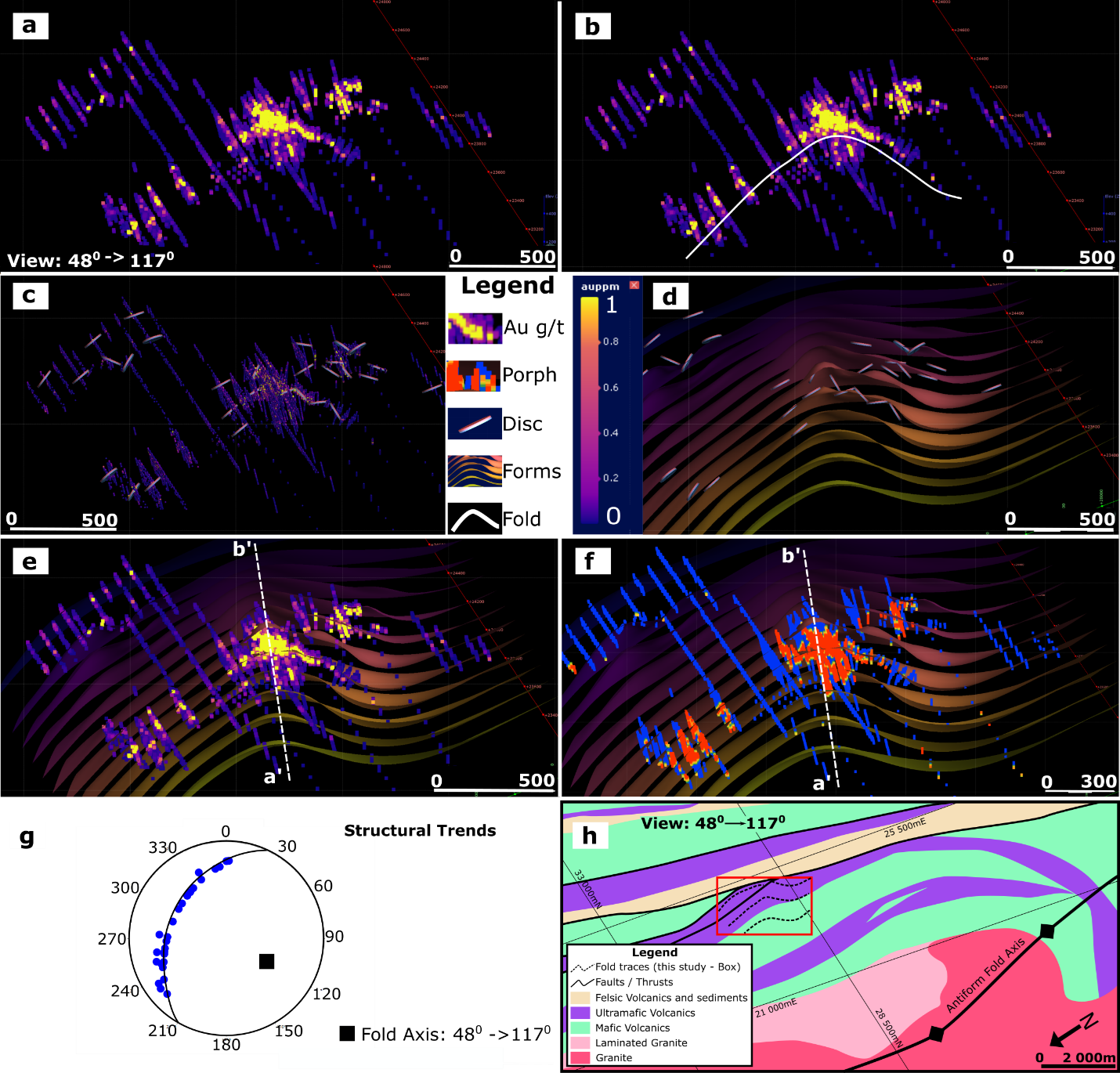
Figure 2. A simple workflow using MIP to analyse a deposit. a) The view with gold projected using MIP looking down plunge at 48→117. b) An apparent fold is identified in the gold data. c) The gold trend has been modelled using a series of structural discs (MIP turned off for clarity). d) A series of structural forms have been modelled based on this structural geological data that model the fold surface. e) The form surfaces are compared against the gold to see if the trends still make sense looking down plunge. f) The same down-plunge view but showing the extracted volume points for the porphyry unit (in red). g) A stereonet of the structural discs shows the poles form a great circle with a pole plunging SE at 48→117. h) The fold trends overlayed onto the regional geology looking down the plunge of the apparent fold axis. Legend: Au g/t is the gold composites in grams per tonne, Porph is the porphyry, Disc means the structural discs, Forms are the structural forms built from the grade composites and fold is the interpreted fold seen in the grade. The a’-b’ line defines a section discussed in the paper.
Practical benefits for industry
Adopting a structurally informed geology-centric approach leads to more realistic domains, greater modelling consistency, faster interpretation and stronger technical defensibility. For companies, this translates to lower downgrade risk, improved investor confidence and better governance of Mineral Resource reporting. It moves away from the “try everything to reduce risk” approach to a geology-first, geological principles-based approach that ensures geology is the basis for the estimate rather than the estimation being a geostatistical box-ticking exercise.
Conclusion
Integrating simple structural principles into everyday modelling practice provides a practical and low-cost method for improving resource confidence. In many cases, better geology, not more complex statistics, offers the greatest return on effort. The key takeaways from the paper are:
- Geological uncertainty dominates resource risk.
- Proper geological and structural interpretation should precede estimation.
- Grade data contain first-order structural information that directly impacts the estimate.
- Axial symmetry constrains valid geological models to a few plausible options.
- Common industry practices can introduce bias that adds significant estimation risk.
- Outside-in workflows improve robustness and reproducibility.
References
Cowan, E.J., 2016. Why I give geological cross-sections the cold shoulder [online]. LinkedIn. Available from: https://www.linkedin.com/pulse/why-i-give-geological-cross-sections-cold-shoulder-jun-cowan/ [Accessed 27 July 2021].
Cowan, E.J. and Hobbs, B., 2024. Perkins Discontinuities: structurally controlled grade patterns diagnostic of late orogenic gold [and other] epigenetic mineralisation. In: Gold24 Proceedings. Presented at the Gold24, Perth, Australia, 28–37.
Cowan, E.J. and Hobbs, B.E., 2025. Perkins Discontinuities: structurally controlled grade patterns diagnostic of epigenetic gold mineralisation at the deposit-scale. Australian Journal of Earth Sciences, 1–41.
Reid, R. and Cowan, E.J., 2019. Toward robust and reliable implicit geological models. In: AusIMM, ed. Eleventh International Mining Geology Conference Proceedings. Presented at the 2020 and Beyond, 11th International Mining Geology Conference 2019, The Australasian Institute for Mining and Metallurgy, Perth, Australia: The Australasian Institute of Mining and Metallurgy, 8.
Reid, R.J. and Cowan, E.J., 2023. Towards quantifying uncertainties in geological models for mineral resource estimation through outside-in deposit-scale structural geological analysis. Australian Journal of Earth Sciences, 70 (7), 990–1009.
Sterk, R., 2019. Domaining in Mineral Resource estimation. In: Proceedings of the 11th International Mining Geology Conference 2019. Presented at the Australasian Institute for Mining and Metallurgy, 2020 and Beyond, 11th International Mining Geology Conference 2019, Perth, Australia, Perth, Australia: The Australasian Institute of Mining and Metallurgy, 1.
Stoch, B., Basson, I.J., Gloyn-Jones, J.N., and Lomberg, K.G., 2022. The influence of variable anisotropic search parameters on implicitly-modelled volumes and estimated contained metal in a structurally-complex gold deposit. Ore Geology Reviews, 142, 104719.