
Webinar: Predicting Porphyry Copper Through Time: Plate Tectonics, Machine Learning, and Exploration Insights
Join the Social and Environment Society and the Geoscience Society for their Webinar: Predicting Porphyry Copper Through Time: Plate Tectonics, Machine Learning, and Exploration Insights.
About this event
This event is part of our four-part webinar series ‘Critical Minerals and Materials: Insights, Innovation and Perspectives’, showcasing Australia’s leadership across the critical minerals value chain. Each session pairs an expert speaker from the University of Sydney together with an industry practitioner, offering complementary perspectives that bridge academic research, engineering practice, and industry application.
As the second instalment of a new AusIMM–Net Zero Institute seminar series, Professor Dietmar Muller and David Turvey predicting porphyry copper through time: Plate Tectonics, Machine Learning, and Exploration Insights.
Copper underpins modern electrification and the transition to low-carbon energy. Most of the world’s copper comes from porphyry copper deposits, very large mineral systems formed when metal-rich fluids are released from magma in the Earth’s crust, commonly above subduction zones.
In these settings, one tectonic plate sinks beneath another, carrying water and other components into the mantle that promote magma generation and metal transport. Although most known porphyry deposits are relatively young, similar systems likely formed much earlier in Earth’s history but were later eroded, with their metals recycled into younger deposits.
Understanding when and where porphyry systems formed is therefore important for reconstructing Earth’s metal cycle and guiding exploration for deeply buried deposits. We have combined global plate-tectonic reconstructions spanning the past 1.8 billion years with a worldwide porphyry database and machine-learning analysis to identify the tectonic conditions most favourable for porphyry formation.
We find that porphyry systems are strongly associated with periods of intense subduction, marked by rapid plate convergence and sustained volcanic activity, which enhance magma production and the transfer of metal-bearing fluids into the crust. These relationships are used to generate maps of porphyry copper potential through time and to highlight regions that may host undiscovered deposits today.
Join us find out more!
Webinar time: 12.00pm - 1.00pm AEDT
Speaker/s
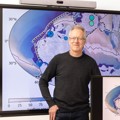
Professor Dietmar Muller

David Turvey
Date and Time
12.00pm – 1.00pm (UTC+11:00)
Cost
USYD Staff & Affiliates: Free
Non-Member: $30