
“Pointing to your own true north”: Kerry Turnock on curiosity, courage and changing the face of mining

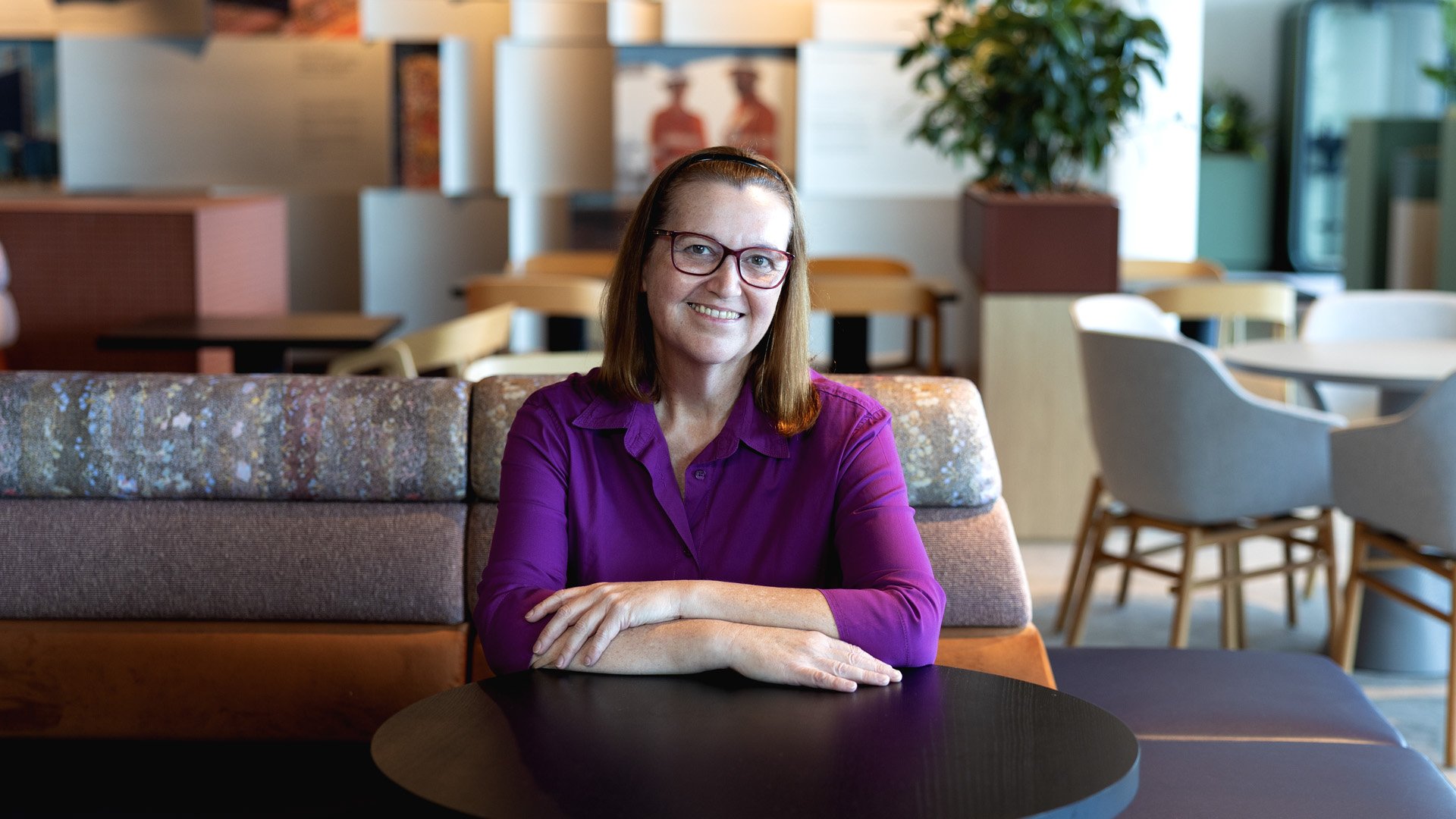
For Kerry Turnock FAusIMM, the journey into geoscience began long before university, long before she stepped onto a mine site, and long before she knew what geology even was. It began in an eight-year-old’s backyard pit, carefully mapping soil layers while other children rode bikes or played cricket.
“I had this inherent obsession with the natural world,” she reflects. “Everything just kept tilting toward science.”
Growing up on the Mornington Peninsula in the 70s and 80s, Kerry was surrounded by teachers, doctors, engineers and farmers but almost no one in the sciences, and certainly no one in mining. Yet what she did have was a family who encouraged curiosity, loved her endless “why?” questions, and let her pull things apart to understand how they worked.
There’s a photo she laughs about - a lawn mower in pieces, her father crouched beside her, explaining the mechanics to a three-year-old Kerry who had simply asked how it worked. “They listened to me,” she says. “They never made my interest in science something unusual or inappropriate for a girl.”
That foundation of curiosity rewarded, science normalised, gender never a barrier, would become the cornerstone of a remarkable career in geology, mining and leadership.
Finding her people: A six-week epiphany
Despite her love of science, Kerry entered university without any real sense that geology existed as a career. That changed immediately.
“I only picked geology because the department was closer to the pub,” she jokes. But within weeks, she experienced what she describes as “a continuous epiphany.”
“It was like I’d found my people,” she says. “Geology blended maths, physics, chemistry, biology, everything I loved, into one beautiful science. That was it. I was going to be a geoscientist.”
The decision was profound. It sparked a career that has stretched across the geosciences, mining engineering, processing, technical marketing, technology and leadership and major technical roles. Decades later, she still describes the Earth with the enthusiasm of someone discovering it for the first time.
“In mining, every day I look at something and think, ‘the Earth is fascinating.’ I get to be curious for a living.”
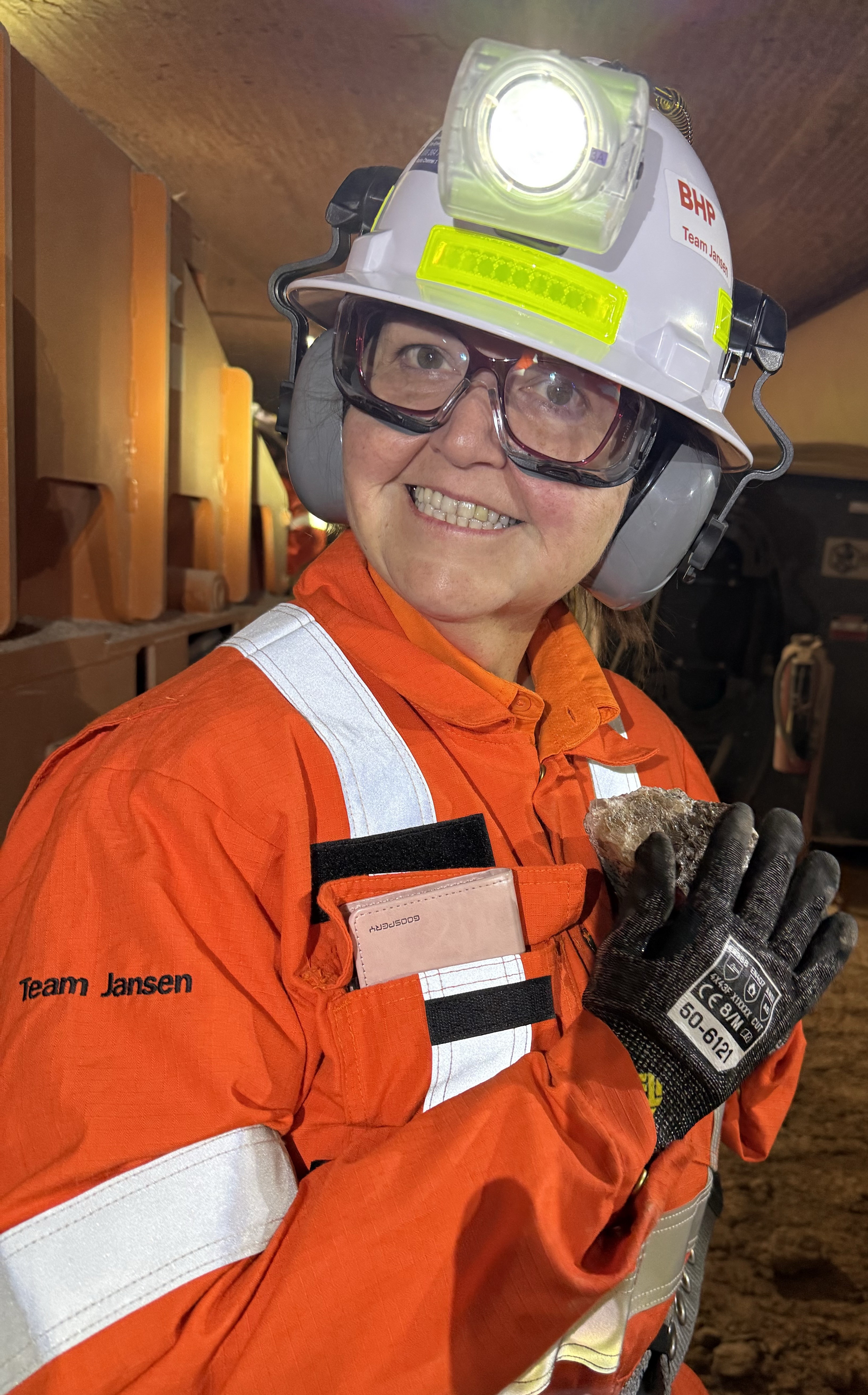
Changing perceptions: “If you can’t see it, you can’t be it”
Throughout the interview, Kerry returns often to a theme that is becoming consistent across this year’s International Women’s Day (IWD) Ambassadors: perception.
“If you can’t see it, how can you be it?” she says. “Children need to see people in roles that excite them, especially girls.”
But it’s not only children who need this visibility. Kerry is adamant that the people who influence children including parents, teachers, and career counsellors must also understand the breadth of opportunity within mining.
“Our educators carry perceptions formed decades ago that mining is dirty, dull and dangerous. And yes, there are parts of the industry that historically fit that description. But today, mining is also data science, advanced technology, automation, environmental management, closure planning, engineering, and sustainable design.”
To demonstrate this, Kerry recently returned to her old high school to speak with the students. Something unexpected happened.
“The teachers were the ones who got as much, if not more, from the session,” she says. “They’d never heard of a geomaterials scientist or a pyrometallurgist. They didn’t know what geophysicists actually do. They couldn’t connect mining to the world around them.”
She describes showing students how geophysics helps predict earthquakes, identifies sinkholes and preserve archaeological sites. “You could see it triggering something. Suddenly science became relevant, exciting, alive.”
Her conclusion is clear:
If mining wants to attract diverse talent, it must educate not only children, but the educators.
Driving Positive Change Together: The power of incremental progress
When asked what “Driving Positive Change Together” means to her, Kerry returns to one of her strongest beliefs: progress happens in small, consistent steps.
“We’re often searching for the big solution. But real change comes from the everyday behaviours and the decisions we make bit by bit.”
She uses gender equality as an example. When she first arrived in Paraburdoo as a young geologist, the town had five allocated women’s rooms in a population of almost 3,000. There simply wasn’t enough accommodation for single women in town and some of us would have to be placed in the single men’s quarters.
“They genuinely didn’t know what to do with us,” she says with a smile. “They sat the three of us down and explained, very seriously, that there were urinals in the bathrooms. I said, ‘We promise not to use them.’ That was the barrier.”
Today, mining camps are gender-neutral, each room has a private bathroom, and security is standardised for everyone. “No one even discusses ‘women’s rooms’ anymore. We made it normal.”
For Kerry, this is the essence of change:
Normalise the right things. Make inclusion ordinary. Remove obstacles quietly and consistently.
No single woman drove this shift, she notes. It happened because more women entered the workforce and more advocates including many male leaders stood beside them, whilst more people in decision making roles refused to accept outdated norms.
“You need someone who calls out what isn’t okay,” she explains, “but you also need sponsors who turn that into lasting action.”
Great sponsors, she says, share three qualities: they listen without judgement, they lead with humility rather than ego, and they make things happen.
“When you have those people around you, change sticks.”
Theory Vs. Application: Bridging the gap
Kerry draws a powerful distinction between theoretical ideals and applied progress.
“Theory is the dream, an ambition, the North Star. Zero harm. Net-zero waste. A fully sustainable mine. But theory is belief. Application is the steps required to get there.”
Her analogy is clear:
“You don’t reach the summit by declaring you want to climb Everest. You reach it one step at a time.”
Being “inside the tent,” she argues, is what allows people, especially underrepresented groups, to turn theory into action.
“If you really want to make a difference, be at the table where decisions are made. Influence from the inside.”
Redundancy, reinvention and the compass that points south
One of the most impactful moments in Kerry’s career came during her first redundancy, an experience she calls both devastating and transformative.
“I linked my personal value to my professional identity,” she says. “When the job went, my self-worth went with it.”
The emotional impact lasted years. But a gift from her manager changed everything: a Chinese compass that points south instead of north, accompanied by a message:
“As a compass it may seem a bit unusual because depending on your viewpoint, it points to the south rather than the north. However, like you it is both very capable and totally reliable.”
This became a metaphor for diversity of thought, something Kerry champions fiercely.
“It reminded me that thinking differently is a strength, not something to hide.”
That redundancy unlocked an opportunity to retrain as a mining engineer, something she would never have considered otherwise. It also taught her resilience, empathy, and the importance of saying “yes” to discomfort.
“I’ve been made redundant three times now,” she says. “I say yes every time, because each step shapes my career and gives me more ways to give geoscientists a voice.”
Reducing barriers: From equipment design to mid-career support
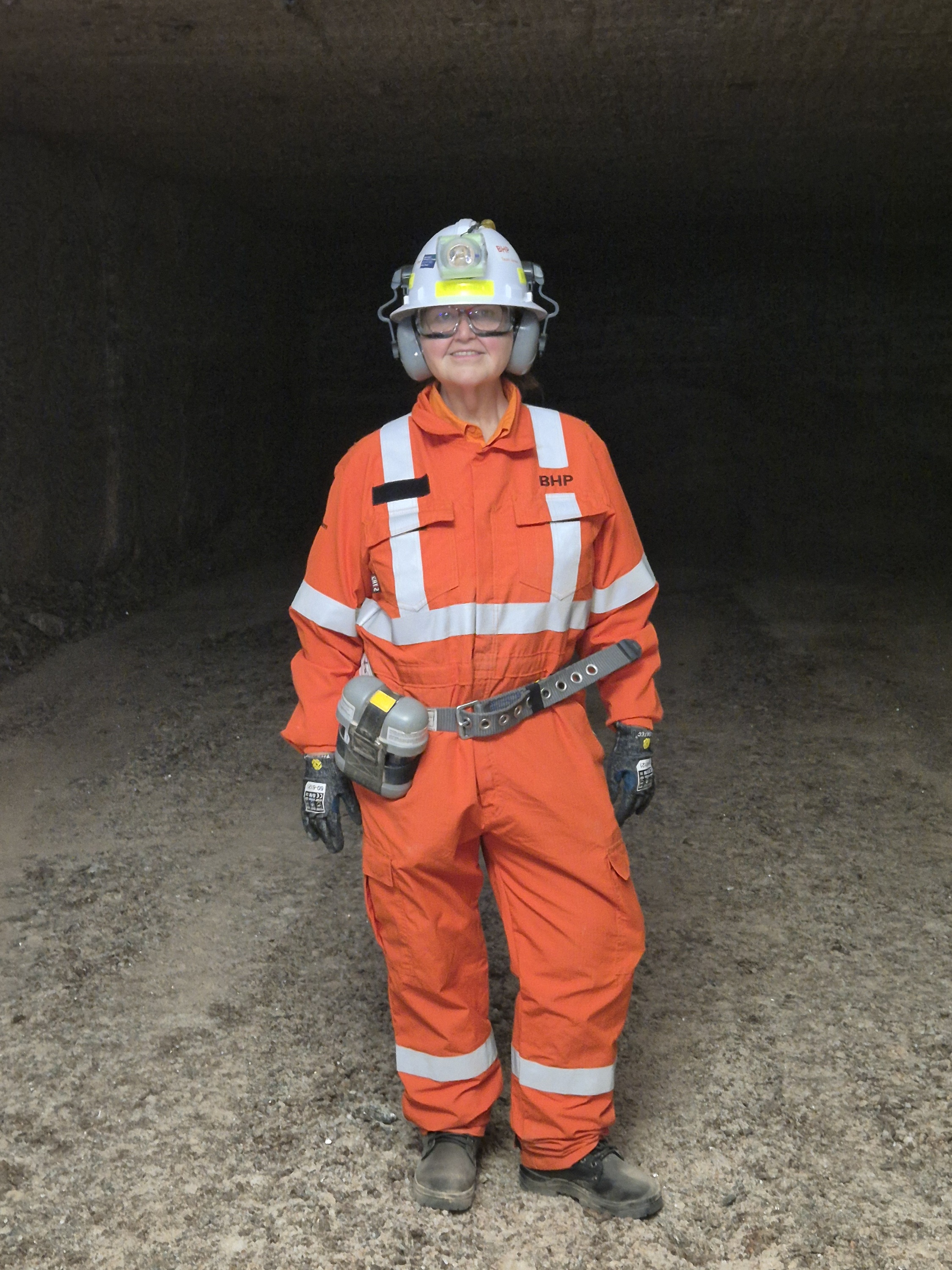
Kerry also highlights practical changes that open mining to more people. She describes a recent BHP safety initiative at Olympic Dam where a redesign in copper processing transformed a previously high strength role into one accessible to a wider workforce.
“For years, only one woman had ever passed the physical requirements. After the redesign, 12 women passed along with men who previously weren’t physically suited to the task. That’s what good design does. It removes unnecessary barriers.”
She stresses that these changes support everyone, women, smaller-framed men, older workers, people returning from injury, and improve safety across the board.
But she also believes the industry must go further, particularly in one key area:
mid-career support for women.
“We focus heavily on early career programs, which is great. But women in the 8-15 year career window often disappear because they don’t see a pathway to the next stage.”
Her call is clear: develop opportunities to diversify skills, expand experience, and rebuild confidence after career breaks.
“That mid-career group is where our future senior leaders come from. We need to invest in them.”
The unlimited budget question: Educating a nation
If Kerry had unlimited resources to drive meaningful change, her answer is immediate:
Educate every educator in the country about the natural world and the mining sector.
Not mining propaganda but science, sustainability, natural systems, and the real skills the industry needs. A national one-week curriculum module, for all year levels, for all teachers, career advisors and counsellors.
“Children are idealistic. That’s good. But we need to connect their ideals with applied action. They need to understand the natural world, how resources support society, and how their talents can shape the future.”
This vision has already seen small successes. Despite being the only geoscientist to graduate from her all female school in 140 years, Kerry now receives letters from students who chose geology and the resource sector after hearing her speak.
“Some are into fossils, some into economic geology, some into metallurgy. It’s brilliant.”
A career built on curiosity, courage and care
Kerry’s passion for people extends far beyond the workplace. She casually mentions, almost as an aside, that she has fostered more than 50 rescue cats including many with behavioural trauma, applying the same principles she brings to leadership: patience, trust, empathy, and belief that every individual can thrive in the right environment.
It is perhaps the perfect reflection of her leadership philosophy.
“Give people a reason to trust. Give them a reason to believe. And the rest follows.”
As she looks to the future, Kerry remains energised by the work ahead. For her, success is simple:
“When I finish my career, I want to know that I gave geoscientists a stronger voice than we had before.”
Through her advocacy, her leadership, her relentless curiosity and her ability to challenge perceptions with warmth and clarity, she is already well on that path.
Stay tuned as we continue sharing more inspiring stories celebrating women in mining.