

Exploring Iron Ore - Geometallurgy and Ore Characterisation
Written by John Clout - Clout Mining
Geometallurgy is a powerful multidisciplinary tool to link iron ore and waste geological properties to downstream metallurgical process performance from comminution to beneficiation, dewatering, materials handling, tailings and waste rock behaviour, sintering, pelletising to smelting behaviour in a blast furnace or in direct reduction iron-electric smelting. Geometallurgy aims to support improved mine planning and predictive modelling, process plant optimisation, reconciliation and minimise unwanted process variations all the way through to inside the customer steelmill.
The key problem is that there are so many different types of primary geological characteristics that could be documented and employed for analysis, some of which may be critical, whilst others may be irrelevant, or important but easily ignored. The fundamental primary characteristics that are known to control iron ore process performance are mineralogy, porosity and hardness, each of which is a product of the geological ore formation process. In contrast, texture can be used to describe the complex mixtures of all three (mineralogy-porosity-hardness) and refers to the 3D arrangement of ore and gangue minerals with porosity. Texture in hematite-(goethite) iron ores typically varies along strike and down dip and is often the outcome of a combination of primary stratigraphy (e.g. Banded Iron Formation (BIF) sedimentary banding), ore forming (leaching and replacement) and geological modifying processes (leaching, metamorphism, and Cenozoic to Recent weathering).
Due to the relatively simple ore (hematite, goethite, magnetite) and gangue (quartz, kaolinite) mineralogy of many hematite-goethite iron ores, it is easy to underestimate the hidden complexities and limitations of using single data type characterisation approaches, for example, geochemistry. In Figure 1, all four specimens have very similar high (67-68 % FeT) grade geochemistry and total mineralogy (97-98 % hematite) but have vastly different porosity-harnesses. Even more so for magnetite BIF orebodies where Fe may not just be in magnetite but also in Fe-carbonates and Fe-silicates, and so contained ‘magnetic Fe’ is far more important. Geochemical data is absolutely critical to understanding 3D variations in chemical composition within an orebody and represents the most commonly available type of data across the industry. However, geochemistry is at best an estimate of mineralogy and is unable to detect either porosity or hardness and hence texture. To gain a better understand of the three fundamental primary characteristics it is necessary to draw deeper into the ore characterisation ‘toolkit’ for other techniques, each with known limitations, including: Hyperspectral data (widely available, spatially agile, but with some mineral and quantification limitations); X-ray diffraction (expensive, spot analysis, more definitive but not reliable at detecting <5 wt. %); Porosimetry (direct, spot analysis, definitive but expensive) or in situ downhole bulk density (cheap, readily/spatially available, poor calliper can yield data useless, smooths real variability); surface area (e.g. BET surface area, spot, definitive but only for finer materials, not lump); particle size distribution ( bulk, spot, but must be linked to mineralogy-texture); Image analysis, either optical reflected/transmitted light (spot, excellent at textures (ore minerals-porosity), not so good at gangue minerals) or SEM-based (e.g. TIMA, great at interpreting ore and gangue mineralogy-texture, measure by size fraction, no porosity, spot data); other downhole tools including natural gamma and magnetic susceptibility (widespread coverage, potential beyond just geological interpretation?); plus many more. How many tools other than geochemistry are in your geometallurgical toolkit?
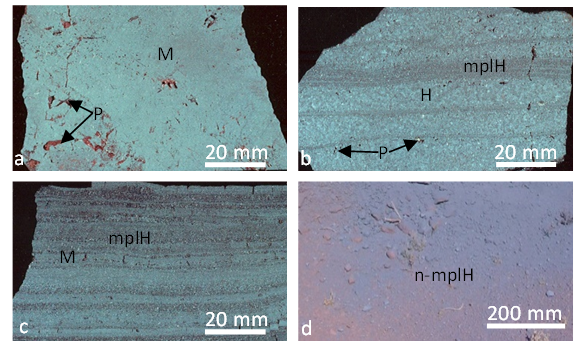
FIG 1 - Examples of different iron ore textures with different porosity-hardness but similar Fe grade (67-68 % FeT) and same mineralogy (97-98 % hematite). (a) Very hard martite (M) with coarse pores but low (<10 vol %) total porosity; (b) Hard microplaty hematite (mplH) alternating with secondary hematite (H), minor pores and low (10-15 vol %) total porosity; (c) Medium hardness microplaty hematite (mplH) alternating with porous martite (M), of medium (15-25 vol %) porosity; and (d) Powdery to friable micro- nano-platy hematite (n-mplH), with very high (30-40 vol %) porosity. (a)-(c) are hand specimens and (d) is an image of powdery material on pit floor.