


Strategic stewardship: why early mine closure planning is central to global competitiveness
As the resources sector looks to the next decade, the measures of success are shifting. In the final instalment of AusIMM’s 2026 Thought Leadership Series, “Global Competitiveness”, Tim Rohde, Chief Executive Officer of SGME, will make a simple point: a mine’s value is no longer defined only by what it extracts, but by how well it is closed and rehabilitated.
For Australian mining to remain a premier destination for global capital, industry must move beyond treating closure as a late-stage obligation. Integrated closure and rehabilitation must become a pillar of strategic stewardship that improves a project’s risk profile and investment appeal.
The cost of delay: a risk impact analysis
Effective rehabilitation is central to the global shift toward high-standard, sustainable mining. SGME’s engagement models show a clear link between when closure specialists join a project and the risk and reward that follow (Figure 1).
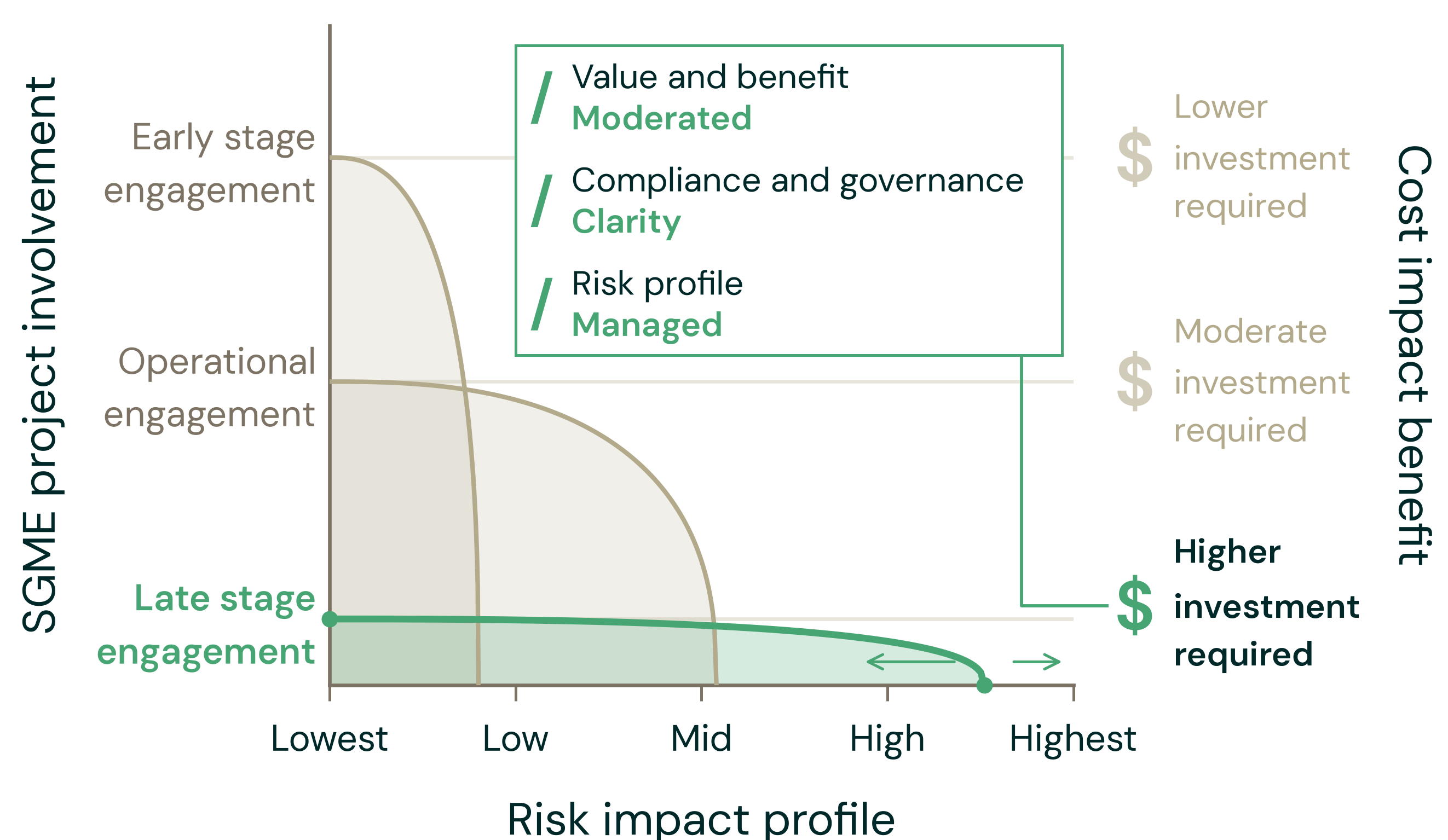
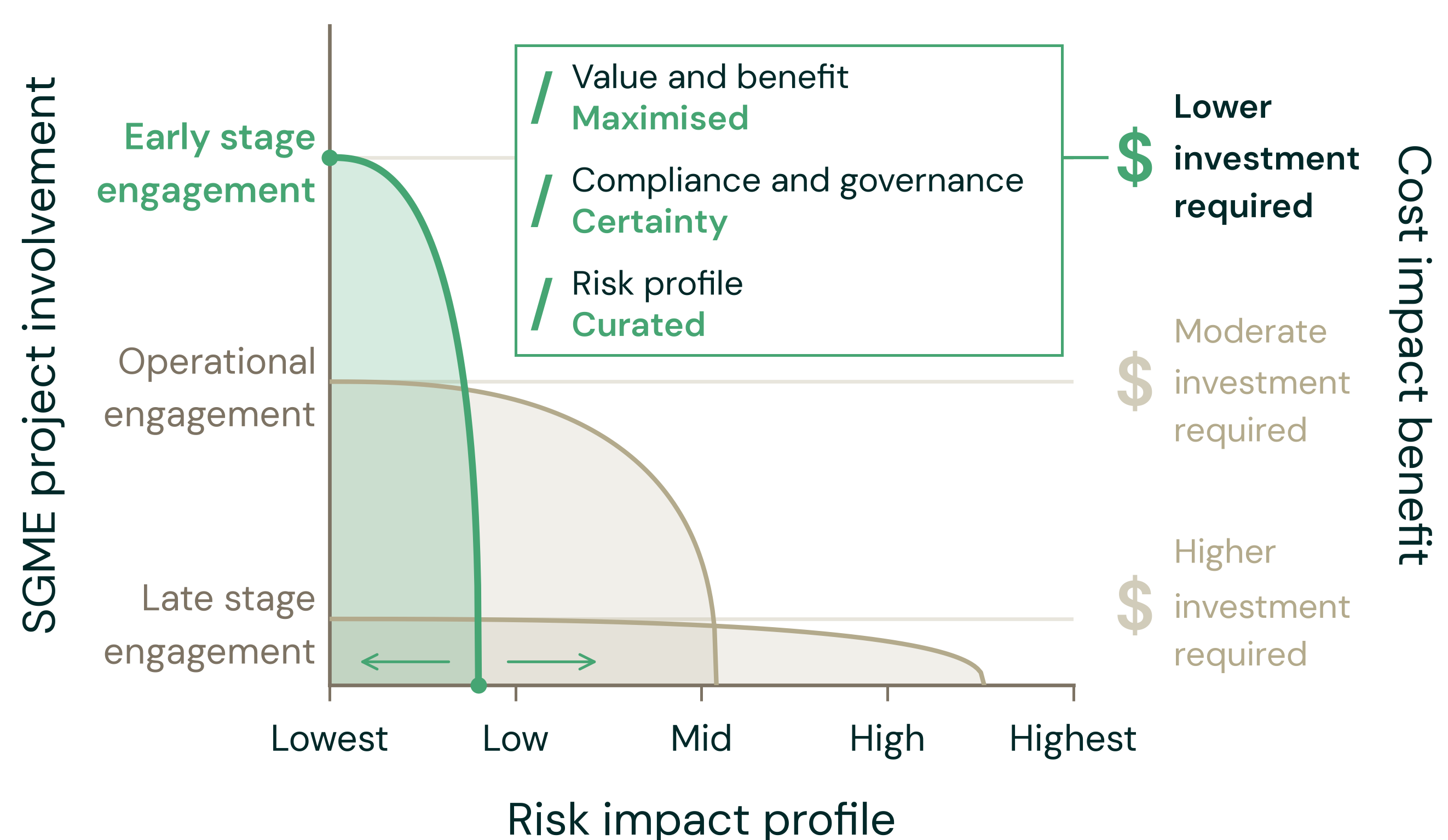
Figure 1 Outcomes of late-stage engagement (left) and early-stage engagement (right)
When operators delay deep engagement with closure and rehabilitation, the risk impact profile shifts to its highest level. At this point:
- risk profile is managed rather than optimised;
- compliance and governance reach clarity rather than strategic certainty; and
- cost impact benefit is at its lowest, and a higher investment is needed to fix legacy issues that earlier work could have avoided.
A case study: closing a heap leach facility
SGME is supporting the closure of a heap leach facility (HLF) at an operating Australian mine. The mine is not named here for confidentiality, but the lessons apply across the sector. The facility is about 20 metres (m) high and covers tens of hectares. It holds ore that was leached with acid during operation. At closure, it must be capped so that rainfall does not pass through it and carry acid and metals into the environment.
The climate is semi-arid, and potential evaporation is about 3.5 times rainfall. That suits a store-and-release cover: an engineered layer that holds rainfall until its release by evapotranspiration and evaporation. The design and construction of this cover show why closure thinking must start early.
The mine plan decides the closure outcome
The cover will be built from non-acid-forming (NAF) waste rock that a mine cutback produces. Closure therefore depends on the mine plan, because waste rock quality and quantity are set at the mining face, before the cover is built. A lower ore reserve meant less NAF waste rock. Designers responded by placing NAF waste rock where risk is highest and by cutting the NAF waste rock foundation under encapsulated potentially acid-forming (PAF) waste rock from up to 9 meters (m) to 5 m.
Modelling set the cover thickness
SGME’s early review asked for modelling over a 100-year climate series, with broader material property ranges that reflect in-situ conditions and bounding cases for sparse vegetation. The final design modelled 12 scenarios against more than 100 years of climate record. Net percolation, the share of rainfall that passes through the cover, ranged from 29 per cent (%) for 1 m of uncompacted waste rock with no vegetation to 2 % for 3 m of compacted waste rock with 30 % vegetation cover. The design therefore uses 3 m of compacted NAF waste rock on the flat-top and 6 m on the embankments. Slope stability and settlement met their criteria. Rock-lined drains are sized for a storm with a 1 % annual exceedance probability, so the design has no off-site discharge.
Field testing changed the construction method
A design only counts if construction can deliver it. SGME is the supervising engineer for the cover works. Test pads of unprocessed NAF waste rock, built 0.5, 1, 2 and 3 m deep, met the permeability target. However, density met its target only to about 1 m of fill depth. Therefore, the construction specification limited lifts to 1 m, set minimum testing rates and required failed areas to be reworked. The design process, making use of test pads, resulted in technically founded, site specific design criteria. Failure to meet the design specification during construction, could result in higher rehabilitation costs.
Site reviews also found legacy problems. Drains were partly filled with leached ore, and filter layers slumped on steep embankments. The team cleared blocked sections and adopted a new embankment method that used geofabric, NAF waste rock and rock protection.
Data now supports the outcome
Fortnightly photogrammetry surveys and geochemical review, with one sample for every 10,000 tonnes (t) of waste rock, track what is placed and where. Monthly inspections are used to check the work. The monitoring plan will include lysimeters and sensor arrays in the cover to measure percolation, infiltration storage, suction, and test whether the cover performs as modelled. A registered professional engineer will certify the as-built design report. Together, these records give regulators, investors, and communities evidence instead of promises.
What the case shows about the future of mining
The case shows that:
- closure is an engineering problem that mining decisions control, so it belongs in mine planning from (before) the start;
- late closure thinking narrows options, because waste rock, landforms, and legacy structures are already fixed; and
- evidence builds trust, because measured results show regulators, investors and communities that after rehabilitation a mine is safe, stable and non-polluting.
Mining’s future depends on access to land, capital and approvals. Demand for metals that the energy transition needs require more mines. Communities and regulators will only approve new mines if industry closes its existing mines well. Every well-closed mine makes the next approval easier. Every poorly closed mine makes it harder, and as an industry we won’t be thanked by our stakeholders for getting rehabilitation ‘mostly’ right. Rehabilitation is therefore not a cost at the end of mining; it is the evidence that mining can continue.
This HLF is an example of late engagement. SGME joined after the mine plan and an initial design were in place. Review, testing and supervision still reduced risk, but options were narrower than they could have been had early rehabilitation planning been adopted.
Early engagement: maximising value and certainty
To remain globally competitive and investable, Tim Rohde advocates early-stage engagement. Bringing rehabilitation specialists and closure planning in at a mine’s inception holds the risk impact profile at its lowest level. This approach turns rehabilitation from a liability into a competitive advantage:
- value and benefit are maximised, because early planning allows progressive rehabilitation, which reduces the final closure bond and improves long-term balance sheet health;
- compliance and governance are certain, because proactive alignment with environmental, social and governance standards keep projects globally relevant and ready for regulatory change; and
- less investment is needed, because managing risk early reduces the total cost of impact and gives stakeholders a better cost impact benefit.
Driving the global shift
The 2026 series theme, “Digital Mines, Diverse Minds”, highlights the need for data-driven closure models. The case study shows what that means in practice: careful monitoring and measurement turn a closure design into evidence. Tim Rohde’s panel in Perth on Thursday 19 November 2026 will explore how rehabilitation planning, execution and monitoring can give the transparency and confidence that modern investors demand.
Mine closure and rehabilitation are the ultimate test of a company’s commitment to its social licence. By showing a credible risk profile through early engagement, Australian mining companies can prove they are not just extractors but long-term stewards of the land. In an increasingly scrutinised global market, this commitment to powering the global shift will define the next decade of Australian competitiveness.
👉 Learn more about the Global competitiveness panel.