
Australian Mineral Review 2023
Australian Mineral Exploration Review 2023. A review of exploration expenditure, commodity trends and significant results in Australia by Joshua Pheeney and Heather Colclough is a Geoscience Australia publication available in digital format. Australian Mineral Exploration Review 2023 (licdn.com) or https://bit.ly/3Yv9acM This annual assessment of Australia’s exploration industry draws on data from the Australian Bureau of Statistics and company reporting to reveal exploration trends, activities and mineral discoveries from across Australia. In 2023, some 77 maiden resource estimates were announced, of which, 36 included a critical mineral and 21 contained a strategic material.
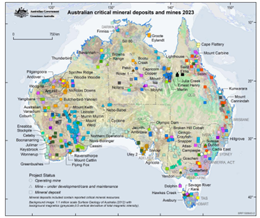
The chapters typically outline a brief introduction, wherein the heart of the publication are the tables of exploration companies, along with an Australian map of localities.
A critical mineral is an element or mineral that is essential for modern technologies, economies or national security, and has a supply chain at risk of disruption. Individual countries develop their own lists of critical minerals. As of February 2024, the Australian Government considers 31 commodities to be critical minerals, of which Australia has reported mineral resources for 27.
Below are extracts related to ore genesis;
All of Australia’s current resources and production of lithium are derived from hard-rock lithium minerals, chiefly spodumene found in pegmatites. These are largely concentrated in the Pilbara and Yilgarn cratons of Western Australia. These mineral deposits are commonly associated with niobium, tantalum and tin mineralisation. Caesium and rubidium are also sometimes found in association with lithium-bearing pegmatites
Australia's known resources of nickel and PGE primarily occur in two deposit types: nickel-copper-PGE sulphide deposits and lateritic nickel deposits. Australia's nickel production is dominated by magmatic nickel sulphides from komatiite deposits in Western Australia. The majority of Australia's nickel resources, however, occur as nickel oxides in lateritic deposits. Australia currently produces only minor amounts of PGE as a by-product of nickel sulphide mining operations. The platinum group elements (PGE) comprise platinum (Pt), palladium (Pd), iridium (Ir), osmium (Os), rhodium (Rh) and ruthenium (Ru) and are amongst the rarest metals on earth.
Australia’s known resources of cobalt can be found in nickel-copper-PGE sulphide deposits, nickel laterite deposits, iron-oxide copper gold deposits and in cobalt-rich, sediment-hosted copper deposits. Australian production of cobalt presently occurs as a by-product of nickel laterite and sulphide mining in Western Australia.
Australia is host to a diverse range of REE orebodies including hard rock, heavy mineral sands and clay-hosted deposits. Known Australian occurrences of scandium are associated with REE deposits and lateritic nickel-cobalt mineralisation, but no scandium is currently being produced in Australia.
Several other critical minerals have featured in exploration results reported in Australia in 2023, including molybdenum, which was added to Australia’s Critical Mineral List in 2023, and antimony, bismuth, gallium, graphite, indium, manganese, rhenium, titanium, tungsten and vanadium. Of note, production of molybdenum in Australia, which ceased in 1978, resumed in 2022, when the Cadia operations in New South Wales commissioned its processing plant to extract molybdenum from copper concentrates
In addition to the 31 commodities on the Australian Critical Minerals list, another five are considered by the Australian government to be strategic materials, namely: aluminium, copper, phosphorus, tin and zinc. However, supply chains are not currently vulnerable enough to meet the criteria for the Australian Critical Minerals List.
Although not included on either the critical minerals or strategic materials list, exploration for other commodities such as gold and iron ore, remain essential to the Australian economy. In 2023, gold accounted for approximately 29% ($1.2 billion dollars) of exploration expenditure.
Australia’s copper is usually found and produced with other commodities in polymetallic deposits, some of which also contain critical minerals such as cobalt and platinum group elements. Exploration and production are dominated by four types of deposit: iron-oxide-copper-gold deposits, sediment-hosted copper-cobalt deposits, porphyry copper deposits and volcanic-hosted massive sulphide (VHMS) deposits.
Lead, mainly in the form of the mineral galena (PbS), is usually associated with zinc, silver and sometimes copper, and is extracted as a co-product alongside these metals. Australia’s lead and zinc occurs in several deposit types including sediment-hosted base metal deposits, VHMS deposits and epithermal deposits.
Silver is often found with and produced as a co-product of lead, zinc and copper, in volcanic massive sulphide deposits and as a by-product of gold, particularly from porphyry copper and iron-oxide-copper-gold deposits.
Gold is found in association with a variety of deposit types including iron oxide-copper-gold, porphyry deposits and orogenic gold deposits, of which, orogenetic gold deposits account for the majority of production in Australia.
Primary Tin ore deposits typically occur within granites or within associated pegmatites or Aplite’s. Carbonate-replacement deposits, such as those found in western Tasmania, form some of the largest tin deposits in Australia. Rubidium and caesium can occur in association with tin in pegmatite deposits.
The most common source of phosphate rock is phosphorite, a marine sedimentary deposit.
Iron - Australia currently holds the world’s largest resources of iron and is the world’s largest producer.
Uranium- Australia has the world’s largest resources of uranium, occurring in four main types of deposit: iron oxide breccia complexes, unconformity-related, sandstone and calcrete-hosted.