
Introducing our New Zealand Education Endowment Trust 2026 Scholarship Recipients
Each year, the New Zealand Branch of the AusIMM Education Endowment Trust (EET) is proud to award scholarships to outstanding students studying minerals-related disciplines across the country.
The program recognises emerging talent and supports students as they build their careers in the minerals industry. Through financial support and opportunities to connect with industry, EET scholars are able to develop practical skills, expand their networks, and gain valuable insight into the profession.
We are pleased to announce this year’s winners and congratulate them on their academic achievements and their contribution to the future of the minerals industry.
Meet our New Zealand 2026 recipients below:
|
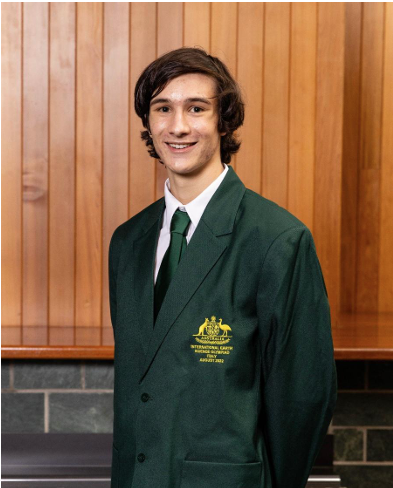
Runar Berntsen
|
Runar is a Bachelor of Civil Engineering (Honours) student at the University of Waikato. His research explores the performance of Limestone Calcined Clay Cement (LC3) produced using locally available materials. The project evaluates the mechanical properties, durability and environmental benefits of LC3 as a sustainable alternative to traditional Ordinary Portland Cement (OPC). By optimising mix designs with locally sourced limestone and clay, Runar aims to better understand compressive strength, long-term performance and resistance to environmental degradation. This research has strong relevance for the minerals industry, promoting the use of abundant, underutilised raw materials. LC3 reduces clinker content, significantly lowering carbon emissions and energy use. The use of local materials also supports regional supply chains and reduces transportation impacts, contributing to more sustainable construction practices. |
|
Emily Froehlich
|
Emily is completing a Master of Science in Earth Science at the University of Auckland and is particularly interested in hydrothermal systems and their applications in mineral exploration. Emily's research develops a conceptual model of magma–fluid–host rock interactions in mafic volcanic systems, using the Ferrar Large Igneous Province in Antarctica as a case study. By analysing mineral assemblages, fluid sources and alteration processes, the project aims to improve understanding of hydrothermal mineralisation. The findings will provide valuable insights for mineral exploration in New Zealand, particularly in regions where direct exposure is limited. By comparing Antarctic data with New Zealand systems, Emily’s work contributes to more effective exploration strategies. |
|
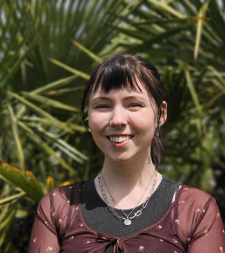
Eva Glucina-Young 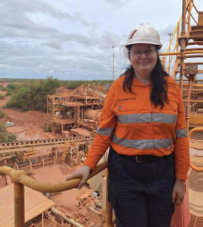 |
Eva is in her final year of Civil Engineering and Earth Science at the University of Waikato. Her project focuses on the sustainable removal of mining contaminants from water using biochar. The research investigates how effectively biochar can treat contaminated mine water and determines when it should be replaced to maintain performance. This has important applications for managing process water, tailings seepage and pit lake water. Eva’s work supports the development of a low-cost, standardised approach to water treatment in mining operations. It also contributes to improved environmental outcomes, particularly during mine closure and rehabilitation. |
|
Ruth Kanipiau 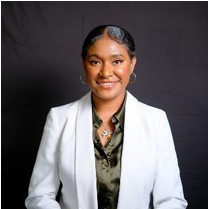 |
Ruth is completing a Master of Science in Geology at the University of Otago, following a Bachelor of Science in Environmental Geology. She brings experience in mineralisation research, geological mapping and geochemical analysis. Ruth’s research investigates the structural and geochemical controls on gold and arsenic mineralisation along the Cap Burn Fault in Otago. Using detailed structural logging and advanced analytical techniques, Ruth aims to better understand how mineralisation occurs in complex geological settings. This work is directly relevant to mineral exploration, particularly as easily identifiable deposits become increasingly scarce. By improving understanding of structural controls, the project supports more targeted exploration and reduces discovery risk. |
|
George Osborn
|
George is a third-year geology student at the University of Otago. His research examines the distribution of gold within fluvial deposits overlying high-grade schists at Rough Ridge in Central Otago. Through detailed field mapping and sediment analysis, he is investigating how geological conditions influence the transport, concentration and deposition of gold in these environments. The findings aim to improve understanding of gold-bearing systems and help identify potential exploration targets. By refining knowledge of these processes, the work supports more effective exploration strategies and contributes to ongoing development of New Zealand’s gold resources. |
|
Alena Saito-Warren
|
Alena is a master’s student and practicing engineering geologist with experience in geotechnical investigations and reporting across residential and extractive projects in New Zealand. Alena’s research focuses on characterising the geotechnical properties of extractive fines to evaluate their potential reuse in construction. Using laboratory testing methods such as scanning electron microscopy and direct shear testing, the project aims to assess material behaviour and suitability for applications, focusing on stabilised roading materials. This work addresses a key challenge in the New Zealand minerals industry, where locally derived materials differ significantly from international counterparts. By developing locally relevant data, Alena’s research supports more sustainable material use, reduces waste, and helps inform future guidelines for alternative construction materials. |
|
Sean Roe
|
Sean is studying at the University of Otago and is undertaking a project focused on marine seismic interpretation. Sean’s work involves processing and analysing seismic reflection data from Caswell Sound in Fiordland to produce a clear image of subsurface geological structures. Using data collected with advanced seismic systems, he is developing skills in interpretation and improving the accuracy of geological modelling. This research contributes to a better understanding of complex geological environments and has potential applications in resource exploration and carbon storage. It also highlights the value of geophysical methods in supporting informed decision-making in the minerals and energy sectors. |
|
William Rolston
|
William is a third-year geology student investigating historic gold workings in the Maerewhenua area. William’s project involves geological mapping, structural analysis and reporting to better understand alluvial gold mineralisation. By linking historical workings with surrounding geology, the research may uncover new insights into deeper, unworked deposits. The research may provide new insights into the region’s gold systems and inform future exploration efforts. It also builds practical skills in field mapping, data interpretation and technical reporting, supporting industry readiness and a stronger understanding of mineral exploration processes. |
|
Kalista Rossiter
|
Kalista is completing a Master of Science in Geology at the University of Canterbury. Her research focuses on developing a passive treatment system for mine drainage from the Snowy River and historic Blackwater mines. The project addresses elevated levels of suspended solids, arsenic and iron, aiming to design a sustainable, low-maintenance solution for water treatment. Laboratory testing will inform system design and effectiveness. This research holds environmental and cultural importance, as the affected waterways feed into the Māwheranui and Māwheraiti river systems. Protecting water quality supports ecosystems, local communities and cultural values associated with these waterways. |